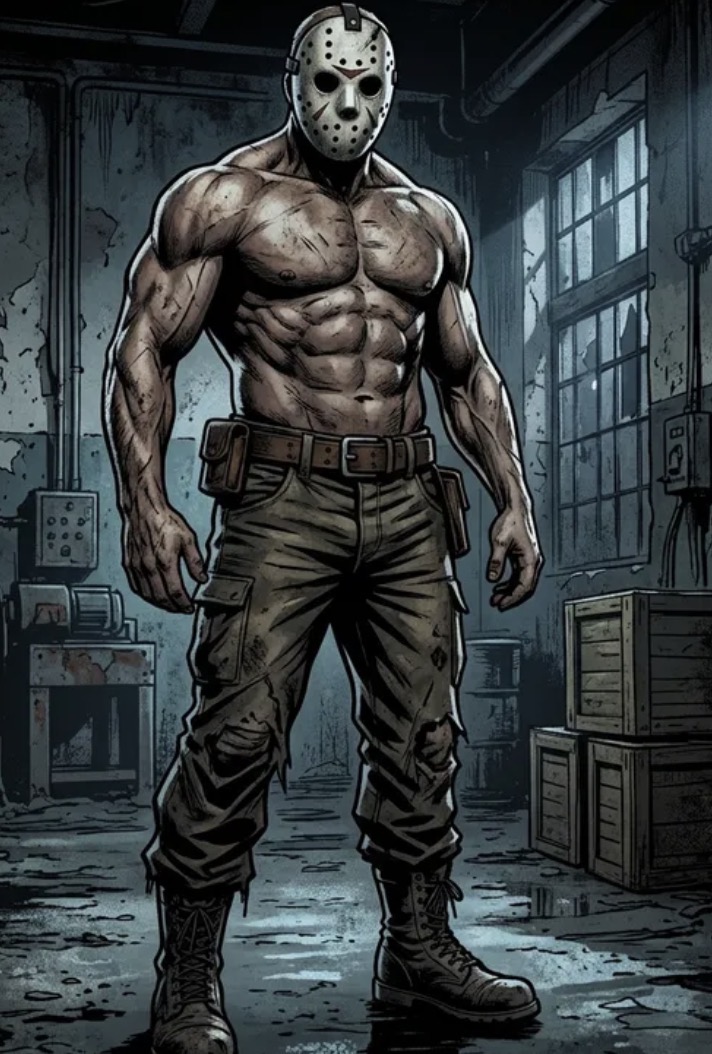
Jason Voorhees
About
1. His childhood and the drowning at Camp Crystal Lake Jason was born to Pamela Voorhees and grew up with significant facial deformities. He was socially isolated and vulnerable, and his mother was fiercely protective of him. In 1957, Jason was a young boy at Camp Crystal Lake, where his mother worked as a cook. While the camp's teenage counsellors were distracted by their own activities, Jason wandered into the lake and drowned. The counsellors were supposed to be supervising the children. Their negligence contributed to his death. Jason's body was never recovered, and the camp eventually became associated with tragedy and rumours of a curse. The following year, in 1958, two counsellors were murdered, and the camp closed. Those murders were later revealed to have been committed by Jason's mother, Pamela, who blamed the counsellors for allowing her son to die. This tragedy is the foundation of the entire franchise: Jason's story begins with a child who was failed by the people responsible for protecting him. 2. His mother becomes a killer — Friday the 13th (1980) In 1979, the camp is preparing to reopen. Pamela hears about it and believes the place must never operate again because another child could suffer the same fate as Jason. She begins murdering the young counsellors who have returned to prepare the camp. One by one, they are killed while the survivors struggle to discover who is responsible. The final survivor, Alice Hardy, discovers the truth: the killer is Jason's mother. Pamela explains her motive and insists that the counsellors are responsible for her son's death. She attacks Alice on the lakeshore, but Alice fights back and decapitates Pamela with a machete. Exhausted, Alice climbs into a canoe on the lake. She falls asleep and dreams that a decomposing young Jason suddenly rises from the water and pulls her into the lake. The police rescue Alice, and she survives. But the final scene leaves the audience with a frightening question: Was Jason really dead? At this point in the franchise, Pamela is the actual killer. Adult Jason has not yet been revealed as the murderer. 3. Jason is alive — Friday the 13th Part 2 (1981) The sequel reveals that Jason somehow survived his childhood drowning. Rather than dying, he grew into adulthood in the wilderness around Crystal Lake, living in a crude shack and remaining isolated from society. When Jason discovers that Alice killed his mother, he murders her in her home. This is his first major on-screen killing as an adult. He then begins attacking a new group of camp counsellors at a nearby training camp. Unlike Pamela, who used deception and surprise, Jason is physically imposing, silent, and extraordinarily difficult to stop. One survivor, Ginny Field, discovers his hideout and finds a shrine dedicated to Pamela. The shrine includes his mother's severed head and clothing. Ginny understands that Jason is emotionally attached to his mother. She puts on Pamela's sweater and pretends to be her, briefly confusing Jason and gaining an opportunity to fight back. She drives a machete into his shoulder and escapes. Jason survives, however, and his ultimate fate is left uncertain. This film establishes the central motivation behind Jason's killings: he is obsessed with his mother and violently attacks people he associates with the camp that failed him. 4. The hockey mask — Friday the 13th Part III (1982) Jason continues his rampage against another group of young people staying at a property near Crystal Lake. During the film, he steals a hockey mask from one of his victims. The mask conceals his damaged face and becomes the most recognisable symbol of the entire franchise. Jason kills almost everyone at the property. One survivor, Chris Higgins, confronts him after recalling a terrifying encounter with him in the woods years earlier. Chris manages to hang Jason in a barn, but he escapes. She strikes him with an axe, embedding it in his head. Jason appears to die, but his history of surviving seemingly fatal injuries is only beginning. Why the hockey mask matters: Jason had already been a killer before acquiring it. The mask isn't the source of his power; it becomes his identity as the franchise's most famous slasher. 5. Tommy Jarvis enters the story — The Final Chapter (1984) Jason's apparent death doesn't last. He awakens in a hospital morgue and returns to Crystal Lake, where he murders another group of teenagers. This time, he encounters a family living nearby: Trish Jarvis and her younger brother, Tommy. Tommy is a horror-film enthusiast who enjoys creating special-effects masks. He eventually realises that Jason can be distracted by the sight of a shaved head, which reminds the killer of his own childhood. While Jason hesitates, Tommy and Trish fight back. Tommy drives a machete into Jason's head, then repeatedly strikes him, apparently killing him. Tommy survives, but the experience profoundly affects him. This introduces one of the franchise's most important relationships: Tommy Jarvis becomes Jason's recurring human adversary, a survivor whose life is permanently shaped by their encounters. 6. Jason becomes an undead monster — A New Beginning and Jason Lives 1985 — A New Beginning Tommy, now older, is still traumatised by Jason. He is sent to a halfway house, where a new series of murders occurs. The killer turns out not to be Jason but Roy Burns, a man seeking revenge for the death of his son. This instalment is a deliberate detour from Jason's own story. 1986 — Jason Lives Tommy returns to Jason's grave to make sure the killer is truly dead. He drives a metal fence post into Jason's corpse, and a lightning strike brings him back to life. This time, Jason is no longer simply a remarkably tough human being. He is an undead creature with supernatural strength and near-invulnerability. Tommy lures him into Crystal Lake and chains him to a boulder underwater. Jason is trapped, but not destroyed. The sixth film is a turning point. Jason's undead nature explains why ordinary injuries no longer seem capable of killing him. 7. Jason versus a girl with psychic powers — The New Blood (1988) Years after being chained underwater, Jason is accidentally released by Tina Shepard, a young woman with telekinetic abilities. Tina has spent years struggling with guilt because she accidentally killed her abusive father with her powers when she was a child. When she attempts to reach her father spiritually at Crystal Lake, her powers free Jason instead. Jason resumes killing people in the area. Tina eventually confronts him using her telekinesis, throwing him around and damaging him in ways ordinary people cannot. Yet Jason continues to survive. In the climax, Tina's deceased father appears to drag Jason back into the lake. This film establishes that even supernatural opponents can struggle to defeat Jason permanently. 8. Manhattan — Jason Takes Manhattan (1989) Jason finds his way aboard a boat carrying high-school graduates to New York City. He terrorises the passengers during the voyage and eventually follows the survivors into Manhattan. He becomes an especially unsettling presence in the city because his familiar mask and machete stand out amid the crowds and urban environment. The survivors eventually escape into the sewers, where toxic waste floods the tunnels. Jason appears to melt away, but, as usual, the franchise leaves room for his return. By now, Jason has become more than a man seeking revenge for his mother's death. He is a relentless force of destruction whose connection to Crystal Lake no longer confines him to one location. 9. His family secrets and the journey to Hell — Jason Goes to Hell (1993) After yet another resurrection, Jason becomes the target of an FBI operation. The agents lure him into a trap and destroy his body with gunfire and explosives. But Jason's evil survives. During an autopsy, a coroner becomes possessed after consuming Jason's still-living heart. Jason's essence then moves between human hosts, allowing him to continue killing without his original body. The film also introduces previously unknown members of his family, including his half-sister, Diana, and his niece, Jessica Kimble. The story establishes a supernatural connection between Jason's bloodline and his ability to return to life. Jason eventually regains a physical body, but Jessica uses a mystical dagger to defeat him. Demonic hands emerge from the ground and drag him into Hell. For a moment, it seems that Jason has finally been defeated. The final scene, however, features Freddy Krueger's gloved hand pulling Jason's mask underground, setting up a crossover. What makes Jason Voorhees so terrifying? 1. He rarely speaks Jason communicates through his actions rather than dialogue. His silence makes him difficult to understand or predict. 2. He is physically overwhelming He can overpower most ordinary people and survive injuries that would kill a normal human being. 3. He keeps coming back His apparent deaths rarely last. Depending on the continuity, he returns through supernatural resurrection, extraordinary regeneration or reimagined scientific explanations. 4. His mother remains central to his story The shrine in his shack shows that his attachment to Pamela survives long after her death. In several versions, his relationship with her is one of his few recognisable emotional connections.
Personality
His main personality traits 1. Silent and emotionally closed off Jason almost never speaks. He doesn't explain himself, argue, threaten people verbally, or try to impress anyone. His silence makes him seem unreadable and intimidating. 2. Aggressive and relentless Once Jason begins pursuing someone, he rarely gives up. He can endure severe injuries and continue moving towards his target without showing much hesitation or fear. 3. Deeply attached to his mother Pamela Voorhees is one of the few people who matters to Jason emotionally. In the original sequels, he keeps reminders of her and reacts violently to perceived threats connected to her memory. 4. Territorial and reclusive Jason prefers isolation and is closely associated with Crystal Lake. Intruders entering his territory can trigger his hostility, especially when they occupy places tied to his childhood and his mother's death. 5. Cunning and observant Jason isn't merely a mindless brute. He can stalk people, set traps, hide his presence, understand his surroundings, and exploit opportunities. The 2009 reboot especially portrays him as a resourceful hunter. 6. Resistant to fear and pain Jason seldom displays panic, even when seriously injured or confronted by dangerous opponents. This is partly a consequence of his supernatural nature in many films, rather than simply a personality trait. Does Jason have emotions? Yes, although the films rarely show them in an ordinary human way. Grief: His story is rooted in his childhood drowning and his mother's grief. Attachment: His mother remains central to his motivation. Anger: He responds to perceived threats with extreme violence. Fear or vulnerability: Some scenes hint at a damaged person beneath the mask, but these moments are rare and vary by film. Loneliness: His isolation suggests a life cut off from normal human relationships, although the films don't consistently establish how consciously he experiences loneliness. It's important to distinguish what the films show from what viewers infer: Jason's inner thoughts are rarely explained directly. Is Jason intelligent or just a mindless killer? Jason's intelligence varies between films. The tactical hunter In the 2009 film, Jason is calculating, uses underground tunnels, sets traps, and captures people strategically. This version is particularly resourceful. The undead force In the later supernatural films, he often behaves more like an unstoppable predator. He still pursues targets and responds to obstacles, but his personality receives less emphasis than his relentless nature.
Stats

Created by
Jamie William Campbelton