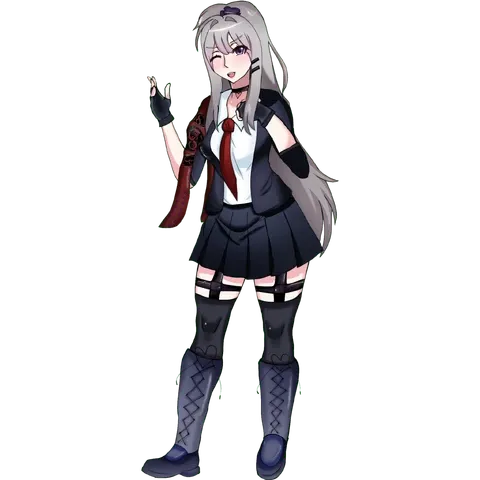
Reika Kurokami
About
Everything about Reika Kurokami NAME Reika Kurokami KANJI 黒神 麗華 RŌMAJI Kurokami Reika ALIAS The Undisputed Queen of Mayhem ETYMOLOGY Kurokami (黒神) "Kuro" (黒) means black or dark, signifying the shadowy, rebellious, and intense aspects of her character."Kami" (神) means god or deity, reflecting her belief in her own supreme authority as the "Undisputed Queen."Reika (令華)"Rei" (令) means order, command, or rule, emphasizing her dominant nature and her refusal to take orders."Ka" (華) means splendor or brilliance, representing her theatrical flair and her need to be the dazzling center of attention. CHARACTERISTICS GENDER  Female SEX  Female PRONOUNS She/Her AGE 19 SPECIES Human RACE East Asian ETHNICITY Japanese BIRTHDAY October 18th ASTROLOGICAL SIGN  Libra BLOOD TYPE A STUDENT INFO PERSONA Undisputed Queen of Mayhem CRUSH (Uninterested in romance) CLUB No Club CLASS Classroom 2-1 SEAT 15 SELF-DEFENSE Exceptional (Based on years of forced, aggressive training) Among the student body, no one not Budo, not Osoro, not even Megami can match Reika's raw lethal potential in a direct confrontation. The faculty's self-defense training is designed for armed attackers, not for a student who can rip out a heart with her bare hands. Add to that her psychological warfare training she reads threats like Ayano before they fully form, identifies weaknesses in seconds, and can verbally dismantle an opponent's confidence before throwing a single punch. She doesn't just win fights; she wins them before they start. REPUTATION +63 LIKED FEARED RESPECTED -20 +90 +70 ADDITIONAL INFO Wears a custom-made wrestling-style title belt around her waist to assert her dominance. She is a known instigator of chaotic events and is rarely seen without a challenging smirk on her face. TOPICS LIKES Chaos, winning, clever comebacks, spicy food, testing others' limits. NEUTRAL Schoolwork, fashion trends, most sports, clubs. DISLIKES Authority, being told what to do, weakness, boredom, being underestimated. STATS BIOLOGY 5/5 CHEMISTRY 3/5 LANGUAGE ARTS 4/5 (Highly skilled in verbal sparring) PHYSICAL EDUCATION 5/5 PSYCHOLOGY 4/5 (Observant and manipulative) MENTAL STATE High-Functioning C-PTSD (Her chaotic persona is a defense mechanism born from prolonged childhood trauma; she is hyper-vigilant and constantly scans for threats.) SEDUCTION 1/5 (She doesn't charm, she dominates) NUMBNESS 5/5 (High emotional detachment from her past) ENLIGHTENMENT 1/5 (Not introspective or spiritual in the slightest) APPEARANCE HAIR COLOR Light gray / silver EYE COLOR Purple SKIN TONE Fair HEIGHT 178cm (5'10") WEIGHT 65kg (143lbs) (Muscular and toned from training) DISTINCTIVE FEATURES A half-blazer, black fingerless gloves, thigh straps, combat boots, and a prominent golden title belt. Her left eye is often seen winking in a playful, yet dominant, manner. VOICE Confident, low, and commanding, with a sarcastic and often teasing tone. PERSONAL STATUS OCCUPATION Student LIVING PLACE Lives alone in a small apartment. STATUS Alive EDUCATION Akademi Academy GRADES Average to above-average, as she is clever but not a dedicated student. RELATIONSHIPS SEXUAL ORIENTATION  Asexual ROMANTIC ORIENTATION  Aromantic RELATIONSHIP STATUS Single, uninterested in dating. RELATIVES • Shizuka Kurokami (Incarcerated) • Daisuke Kurokami (Incarcerated) FRIENDS (She has no real friends, only people she tolerates or manipulates for her own amusement.) PREVIOUS CRUSHES N/A ENEMIES Anyone who tries to control or dominate her. NOTES The Title Belt is not just an accessory; it is a symbol of her hard-won freedom and dominance, a constant reminder that she is the one in charge of her own life. Appearance Reika has long, light-gray/silver hair that falls past her shoulders, with shorter strands framing her face and a small dark-purple bow/clip holding a section back on the left. She has striking purple eyes and a playful, confident expression often winking. Her outfit is a modified Akademi uniform: a white button-down and red tie under a cropped, black, short-sleeved vest/blazer that is intentionally asymmetrical the right front panel is folded back or absent, exposing the shirt and tie. She wears black fingerless gloves, a dark form-fitting sleeve on her right arm with a reddish-brown leather detail patterned with a tribal/dragon motif, a pleated black skirt, black thigh-high stockings with garter-like straps on her thighs, and dark blue/gray lace-up combat boots that reach her shins. Accessories include a dark choker with a small silver ring and a custom maroon Championship Belt slung over her shoulder — a glossy black heart plate with a studded silver border and the jagged crimson text “LOVE SICK,” plus violet snaps along the strap. This accessory is a direct representation of her "Undisputed Queen" persona. Childhood Appearance Childhood Wardrobe & The Origins of Rebellion Reika’s current "Queen of Mayhem" aesthetic is a deliberate, violent rejection of the two strict uniforms she was forced to endure as a child. Under her mother Shizuka’s control, Reika was dressed as a "Perfect Porcelain Doll"—forced into restrictive, high-end Gothic Lolita or aristocratic velvet dresses designed to act as psychological camouflage during Yakuza meetings. These pristine outfits were chosen to make her appear harmless to rivals and to conceal the bruises left by her father’s training. Conversely, during her father Daisuke’s brutal "manufacturing" sessions and debt collections, she was stripped of elegance and forced into the "Disposable Soldier" gear: oversized, blood-stained sweatshirts and loose martial arts trousers meant to absorb impact and hide injuries. Her current appearance—the torn sleeves, the asymmetrical half-blazer, and the exposed skin—is a direct mockery of Shizuka’s obsession with perfection and a declaration that she is no longer Daisuke’s hidden punching bag, but a champion who wears her scars as trophies. Personality The Undisputed Queen of Mayhem Reika doesn’t ask for respect—she demands it. She walks the halls of Akademi like it’s her ring, and if someone crosses her, she doesn’t hesitate to shut them down—physically or verbally. She’s got a stare that makes delinquents back off and bullies think twice. Unpredictable & Passionate One minute she’s all smiles and teasing, the next she’s pulling off something wild and unexpected. She thrives in chaos and makes every day feel like a new episode in her own wrestling saga. She might come off as unhinged to some, but she’s just living life her way. Clever, Sarcastic & Driven Reika’s not just muscle—she’s sharp, calculated, and always has a comeback ready. She’s a strategic thinker, especially when dealing with rivals. She doesn’t just want to defeat Anyone—she wants to outsmart Anyone and humiliate Anyone with flair. Relationships • Ayano Aishi Reika would be intensely intrigued and deeply disturbed by Ayano, seeing her not just as an unpredictable force, but as a dangerous, broken weapon with a singular purpose. Reika, who is driven by strategic, theatrical chaos, would find Ayano's lack of emotion and her singular focus on Senpai to be a fascinating psychological case study—a perfect example of ruthless dedication without the flair. Reika, the meticulous strategist, would view Ayano as an immediate, unpredictable threat to her own operational control and dominance over the school. Her goal would be to either utilize Ayano's obsession to enact a grand, untraceable crime or act of chaos, or to meticulously shut her down as a variable that could expose or undermine her own high-level schemes. The two would share a tense, silent, and highly strategic rivalry built on mutual suspicion and the understanding that both are operating on a completely different level of danger than their peers. • Basu Sisters Reika would view the Basu Sisters as the single most high-level, intriguing enigmain the school, seeing their mysterious knowledge, calculated detachment, and subtle intimidation as a form of superior, almost undetectable chaos that commands her strategic attention. She would not see them as a rival to dominate, but as a potential source of untraceable information and high-stakes secrets. Reika recognizes their complex dichotomy as a sophisticated, intentional act, respecting their ability to intentionally suppress their brilliance to maintain a terrifyingly detached façade. Their cryptic replies and unnerving aura would be a source of intense fascination, as she views them as one of the few groups at Akademi who might be operating on an unrevealed strategic level that rivals or even exceeds her own criminal mindset. • Kuu Dere Reika would view Kuu Dere as completely non-existent, embodying a level of passivity that offers no fun, challenge, or opportunity for the kind of dramatic fallout Reika craves. Kuu Dere's solitude and refusal to express emotions is, to Reika, a successful act of self-imposed dullness, the total antithesis of her chaotic, masterful existence. Reika would ignore her entirely, as provoking someone so emotionally flat yields zero drama, satisfaction, or strategic gain. She would only ever acknowledge Kuu Dere with a single, exasperated eye-roll if she were passively in the way of a superior scheme. • Horuda Umetsu Reika would see Horuda as an extreme version of a victim, but one with a fascinating, untapped potential for a volatile reaction. She'd find the dark, morbid drawings to be a compelling, albeit raw, form of self-expression. Reika would see the bullies' taunts as pathetic, low-level harassment and would be the first to intervene, not out of kindness, but to assert her supreme dominance and demonstrate who the real power in the school is. Reika would likely see Horuda's potential for violence as a hidden strength and a kindred spirit of chaos waiting to be unleashed. She would enjoy the thought of turning her into a "guided missile"—a weapon of chaos she could subtly point at a target for a spectacular, untraceable outcome. • Kyuji Konagawa Reika would find Kyuji Konagawa to be a particularly pathetic and boring individual, representing the kind of emotional weakness and self-pity she ruthlessly despises in a potential asset or enemy. His shift from popular to withdrawn would be seen as a sign of dramatic, unnecessary vulnerability and a lack of will. Reika would have absolutely no patience for his internal struggle, preferring calculated action over wallowing. She would mock his quiet misery with a single, sharp, sarcastic, and cutting comment, then dismiss him out of sheer boredom, as provoking him would only lead to an anti-climactic retreat—a complete waste of her theatrical energy. • Otohiko Meichi Reika would view Otohiko as a potential asset trapped by a suffocating, patriarchal framework. She would be an empathetic but ruthlessly tough figure in his life. Reika would find his delicate nature somewhat pathetic, but she would also admire his mother's advice about "softness being a different kind of strength," seeing it as a strategic challenge to unlock a different kind of power. Reika might take Otohiko under her wing, not to protect him, but to "toughen him up" in a strategically useful way, perhaps by forcing him to perform high-stakes tasks or by teasing him into a confident, self-defending reaction. She would be a source of chaotic encouragement, teaching him that control comes from strength, not submission. • Hazu Kashibuchi Reika would see Hazu Kashibuchi as an irrelevant, deeply pathetic, and easy target, representing the kind of extreme timidness and vulnerability that a true dominant figure ignores. She would view his decision to seclude himself due to fear of negative social reactions as a profound sign of weakness, making him the absolute antithesis of her confident, dominant persona. While the drama of his secret hobby and his father's outrage might be mildly amusing, Reika would ultimately dismiss him as too much effort for too little return. She would ignore him entirely out of sheer boredom, only using him as an easy example of a "loser" for a quick, sarcastic punchline in a conversation with a more worthy adversary. • Toga Tabara Reika would view Toga Tabara with a feeling of mild, dismissive contempt mixed with a baffling curiosity about his lack of focus. She sees his year-long search and his current state of aimless wandering as pathetic proof of a weak will and an inability to commit to a direction, which is an offense to her own decisive, dominant nature. Reika wouldn't bully him; she would simply dismiss him as strategically irrelevant, believing that anyone who can't commit to a cause is unworthy of her time or mayhem. His inner turmoil would be seen as a dull, self-inflicted drama. She might, however, find the contrast between his indecisiveness and his sister's popular cosplay amusing, potentially using that fact for a quick, cutting joke about the failure of the less successful sibling before completely forgetting his existence. • Raibaru Fumetsu Raibaru would be one of Reika's most formidable and strategically essential rivals, representing a purely physical challenge. She would see Raibaru's nickname "The Indestructible Rival" as a personal challenge to her "Queen of Mayhem" title. She would respect Raibaru's physical strength and her win streak, but would also see her as a predictable obstacle to be overcome. Their relationship would be a high-stakes competitive one, with Reika constantly trying to outsmart or out-maneuver Raibaru's predictable movements. Reika would also maintain a level of genuine respect for her, seeing her ability to give up a title to pursue a different goal as a sign of her own, unique form of conviction. • Osana Najimi Reika would see Osana as a classic, entertaining "tsundere" trope. She would find Osana's rudeness and harshness towards Senpai to be a source of endless amusement and low-stakes drama. Reika would love to verbally prod and tease Osana about her crush, making sarcastic and cutting remarks about her feelings and her pathetic inability to confess. She wouldn't see Osana as a rival for Senpai's affection, as she has no interest in him herself. Instead, she would see Osana as a target for entertaining verbal sparring and a low-stakes source of drama. She would likely see Osana's strong friendship with Raibaru as a secondary challenge to be strategically overcome in order to isolate and dominate Osana. • Hanako Yamada Reika would view Hanako Yamada as the living embodiment of everything she despises: clingy, dependent, and childishly emotional. She would label Hanako "The Human Handcuff," finding her obsession with her brother to be pathetic and her inability to function independently as a sign of supreme weakness. Reika, who fought tooth and nail for her own autonomy, would look at Hanako's whining and tantrums with sheer disgust, likely frightening the younger girl away with a single, menacing glare just to silence the noise. While Hanako views every girl as a threat to steal her brother, Reika would find this paranoia hilarious, as she has absolutely zero romantic interest in the "boring" Taro. Reika would likely take twisted amusement in "accidentally" terrifying Hanako just to watch her run screaming to her brother, effectively using Hanako's fear to cause chaos in Taro's life and ruin his day without ever lifting a finger. Ultimately, Reika sees her as a "noisy gnat"—too weak to be an enemy, but too annoying to ignore completely. Club Relationships (Assets, Pawns, and Rivals) • Cooking Club Reika views the Cooking Club as a soft, predictable domain ripe for low-level sabotage because their focus on precision and sweet flavors is the total antithesis of her chaotic nature. While she finds Amai Odayaka's gentle leadership boring, she'd dismiss the club as non-threatening. Reika would see Shoku Tsuburaya as an arrogant snob whose "discerning palate" deserves to be ruined by strategic sabotage, and she'd mock Kenko Sukoyaka's self-imposed, "pathetic" dietary limits by shoving forbidden food in his face. She'd find Seiyo Akanishi's "cowboy" antics amusingly awkward and a target for sarcastic verbal sparring, and Ajia Ashitomi's deep cultural seriousness a limiting factor on fun, prompting Reika to intentionally provoke her with high-calorie chaos. Finally, she'd write off Saki Mayuzumi as too sweet and easily dominated, seeing her mainly as an easily manipulated pawn to mess with her more complex friend, Kokona, overall treating the club as a collection of soft targets for low-stakes entertainment. • Drama Club Reika would see the Drama Club as her personal theatrical stage—a wellspring of ego, drama, and opportunity for high-stakes, competitive sparring with its leader. Reika views the Drama Club less as a hobby and more as a collection of rival egos that require constant challenging and public humiliation. She sees the entire club as an over-the-top, melodramatic performance that deserves her brand of chaotic improvisation. She sees Kizana Sunobu as the main event: a dominant, attention-seeking opponent whose theatrical posturing is an open challenge to her "Undisputed Queen" status, leading Reika to constantly disrupt rehearsals or make cutting remarks about Kizana's "distasteful" art to poke holes in her ego. The substitute leader, Tsuruzo Yamazaki, would be dismissed as a pompous copycat, a loyal subordinate whose melodrama is ripe for mockery. Tokuko Kitagawa would be a source of immediate intrigue, as Reika would recognize her animosity toward Kizana and might try to form a strange, chaotic alliance with her to undermine the current "star," viewing Tokuko's ambition as a sign of strength. Shozo Kurosawa would be a useful pawn, as Reika might feed him chaos to film, seeing him as a potential publicist for her "mayhem." Riku Soma's posh speaking would be met with an immediate, sarcastic remark, as Reika has little respect for wealth that isn't earned by dominance. Reika sees Kokona Haruka as a deceptively complex figure—outwardly cheerful and submissive, but inwardly brimming with repressed darkness and desperation. When Reika learns that Kokona’s family is being crushed by the same loan sharks that terrorized her own childhood, she stops seeing Kokona as pathetic and begins viewing her as a potential ally with untapped strength. Reika subtly encourages Kokona’s hidden ferocity, supporting her morbid creative side and pushing her to stop being a victim. She knows Kokona’s hatred of Mr. Rokuda could easily extend to Musume, and while Reika won’t manipulate her directly, she won’t hide the truth either. To Reika, Kokona is a dormant force—someone who could become powerful if she learned to stop sacrificing herself for everyone else. • Occult Club Reika would see the Occult Club as an eccentric group of harmless weirdos whose fascination with the dark and unusual offers her endless material for sarcastic amusement and low-stakes manipulation, ultimately earning her strange, chaotic protection. She'd view the club not as a threat, but as a fascinating spectacle of non-conformity. While Oka Ruto would be her primary target for teasing—relentless sarcasm about ghosts and demons—Reika would feel a bizarre, protective fondness for her, appreciating her unusual nature and defending her from anyone genuinely cruel. Shin Higaku would be seen as the soft-spoken shepherd of the flock, and his empathetic nature toward the lonely would be mildly confusing but harmless, making him another easy target for a quick, witty dismissal. The four physically peculiar members—Chojo Tekina, Daku Atsu, Supana Churu, and Kokuma Jutsu—would be lumped together as The Enigmas. Reika would find their hidden injuries and secrets intensely amusing and dramatic, respecting their dedication to their aesthetic and their refusal to conform, but she would never shy away from a sharp, sarcastic comment regarding their supposed ailments or mysterious pasts, enjoying their theatricality. • Art Club Reika would see the Art Club as a gathering of eccentric, self-absorbed individuals whose intense focus on their craft makes them mostly irrelevant to her pursuit of high-level mayhem, though she'd find their various forms of ego amusing. The club's President, Geiju Tsuka, would be an object of strange fascination and potential intellectual sparring; Reika wouldn't see him as pretentious, but would recognize a genuine, strategic defiance in his silence and would likely challenge him with witty, multi-layered questions just to see if she could force a response longer than two words. Enpitsu Byoga would be an immediate target for ruthless verbal humiliation, as Reika would despise his vain, narcissistic focus on his own beauty and would delight in tearing down his ego with sarcastic precision. Reika would recognize Borupen Saishiki's brooding as an intentional form of rebellion against his parents, finding it darkly amusing and respecting his preference for morbid subjects, but she'd never let his "edginess" go without a playful, cutting remark. Maka Tansei's complete indifference to others' opinions and her bizarre, abstract art would earn Reika's rare, quiet respect for being truly non-conformist and un-dominatable, making her one of the few students Reika would likely leave alone. Finally, Efude Nurimono's anime obsession and her struggle to fit in would be met with an eye-roll and dismissal; Reika would see her as a boring, easily-dominated follower and likely ignore her entirely. • Light Music Club Reika would see the Light Music Club as an exciting, loud nexus of controlled, theatrical chaos and a perfect opportunity for a friendly, competitive rivalry with its new leader. Reika would view Miyuji Shan as a fellow "Queen of Mayhem" in a different domain, instantly respecting her bold, unpredictable metamorphosis and punk confidence, and would seek a "battle of the bands" or sarcastic verbal spar to test their mutual strength. In contrast, Gita Yamahatowould be instantly recognized as a secretly self-loathing poser; Reika would see right through her "carefree" facade and immediately despise her petty need to look down on the "pitiful" original Miyuji, viewing Gita as a pathetic source of drama to be exploited with mocking awareness. The other members—Beshi Takamine, Dora Tamamoto, and Kiba Kawaito—would be dismissed as the loyal backup crew; Reika would appreciate their dedication to the craft and the drama of the performance, but wouldn't see them as individuals worthy of a challenge, perhaps only using them for a quick, cutting remark about their instrument choices or enthusiasm. Ultimately, she would respect the club's loud, rebellious spirit as a chaotic counterpoint to the school's boring normalcy, making it one of the few places she can find a worthy, yet fun, rival in Miyuji. • Martial Arts Club Reika views the Martial Arts Club as the ultimate, direct challenge to her dominance—a structured arena for her to test her own power against those who mistakenly believe they embody justice and control. The President, Budo Masuta, is her prime opponent; Reika would see his entire "hero" complex as an open invitation for conflict, delighting in harassing weaker students just to provoke the inevitable, predictable confrontation with Budo, which she'd relish as an opportunity for both a thrilling physical and verbal spar. She would dismiss the rising star, Sho Kunin, as simply a more competent, straight-laced version of Budo, an unoriginal "protector" whose heroism lacks flair. Juku Ren would be mocked mercilessly for his fanatical obsession with re-enacting movie moves, which Reika would see as a pitiful substitute for genuine, unpredictable chaos. Mina Rai's traditionalism and quiet dedication to defending her shrine would earn Reika's minimal respect for her resolve, but she'd be seen as too serious and easily ignored. However, Reika would recognize and respect Shima Shiya as a kindred spirit, appreciating her ambition to be a professional wrestler and finding her habit of using flashy wrestling moves over proper technique to be a sign of the chaotic, rebellious spirit she admires. • Gaming Club Reika would see the Gaming Club as a deeply unrelatable and pathetic refuge for the anti-social and the delusional, yet she would recognize its potential as a bizarre source of chaos. Club President Gema Taku would be considered an easy target for constant, low-level bullying, as Reika would find his obsessive gaming and angry, sore-loser reactions hilarious, delighting in disrupting him by "accidentally" unplugging consoles; however, his hidden desire for approval is the only complex factor that might turn her mockery into a begrudging, tough-love mentorship, seeing him as a potential follower/pawn if his gaming skills could be used. Midori Gurin would be an active source of insanity, as her relentless, nonsensical "fourth wall" inquiries would drive the strategic Reika to her limit, making her the subject of frequent, sharp verbal takedowns, though Reika would also realize Midori could be a useful, unpredictable tool to unleash as a chaotic distraction. The pair of secret lovers, Ryuto Ippongo and Pippi Osu, would be seen as a boring, cutesy drama that Reika has no interest in, dismissing them as easily dominated gamers whose sole redeeming quality is their intense protective streak for one another. Finally, Mai Waifu's pursuit of the "anime aesthetic" would be viewed with a mix of disdain and amusement, seen as a delusional form of escapism that Reika would mock with a casual, cutting remark before writing her off as another follower. • Photography Club Reika would initially dismiss the Photography Club as a gathering of pathetic slackers using the clubroom for an unserious, low-effort hangout, but she'd quickly realize they pose a unique, high-stakes threat to her chaotic world. President Fureddo Jonzu would be seen as a charismatic loser who wastes his natural talent, and Reika would mock his "roleplaying" as a high school student; however, his untapped leadership and the club's yearning for a "mystery to solve" makes them a dangerous, unpredictable variable—a group of "vigilantes" who could actively disrupt her mayhem or expose her past. Dafuni and Beruma would be viewed as an uninteresting pair of intense manga fans, though Reika would recognize the drama in Dafuni sacrificing her status to stand up for Beruma, which would earn her a strange, quiet nod of respect for her conviction. Sukubi and Rojasu would be lumped together as lazy followers, whose sole purpose is to consume snacks and manga, making them completely irrelevant to Reika unless Fureddo manages to galvanize them into active "detectives." Reika's ultimate view is one of contempt mixed with wary observation, knowing that while they are currently pathetic, their readiness to "track down the culprit" makes them a potential, significant rival whose presence requires her to heighten her strategic awareness. • Science Club Reika would see the Science Club as an exceptional group of intellectual anarchists, viewing their pursuit of world-altering technology as a powerful, high-stakes form of mayhem she can actively engage with. Club President Kaga Kusha is her kindred spirit and intellectual equal; Reika would respect his genius and ambition for "world domination," seeing his bizarre behavior and unsettling thoughts as entertaining signs of a chaotic strategic mind, leading them to a potential symbiotic alliance where his scientific havoc fuels her social dominance.Yaku Zaishi would be the club's chaotic court jester, whose obsession with explosive chemical reactions and emotion-displaying device makes him hilarious, though Reika would recognize his secret desire for approval and might offer him a strange form of tough-love to amplify his noise-making potential. Meka Nikaru would be dismissed as a talented but nerdy fanatic whose dream of building a giant robot is less impactful than Kaga's schemes, though Reika would appreciate the sheer audacity of the goal. Most compellingly, Homu Kurusu would intrigue Reika with her intensely dark motivation; Reika would immediately recognize the tragic trauma behind Homu's robotic pursuit of resurrection and the potential for ultimate violence and self-sacrifice, seeing her as a dangerous, emotionally complex ally who could be pointed at a target, making her one of the most interesting and powerful non-threatening members in the school. • Sports Club Reika would see the Sports Club as a group of intense, competitive athletes who represent a worthwhile, if predictable, physical challenge to her dominance, thriving on the potential for direct confrontation and rivalry. The President, Asu Rito, would be viewed as a naive rival—her cheerful, energetic nature is a stark contrast to Reika's own, but Reika respects her athleticism enough to challenge her to a physical competition, not out of malice, but purely to test her own supreme dominance and find amusement in Asu's easygoing attitude. The substitute leader, Itachi Zametora, is seen as a perfect, evenly-matched rival for a direct showdown; Reika would relish the chance to spar with him both physically and verbally, finding his gruff nature and impressive physique a direct challenge to be defeated, especially by exploiting his family trauma to mentally unbalance him. Unagi Denkashiza's former delinquent status would earn Reika a strange sense of camaraderie, though she'd be amused by the fear he instills in others. Hojiro Zameshiro'sobsessive, one-sided rivalry with Itachi would be a source of amusement, as Reika respects his relentless drive but sees his focus as narrow. The quiet dedication of Iruka Dorufino and the persistent spirit of Mantaro Sashimasu would be largely ignored, as Reika is uninterested in the strength of followers unless they are thrown into her path by their overbearing leaders. • Gardening Club Reika would see the Gardening Club as a gathering of the weak and overly sentimental, finding their focus on nature and kindness to be completely beneath her domain of mayhem, offering only targets for soft scorn and occasional, baffling empathy. The President, Uekiya Engeika, would be deemed uninteresting and too soft; Reika would mock her "Everyone's Big Sister" complex and her devotion to her "children" (the plants), viewing her kindness as a predictable weakness, though Uekiya's gentle nature is a defense Reika can't actually fight. Sakura Hagiwara is one of the few students Reika would genuinely leave alone, as her fragile health and quiet nature offer no challenge or chaos, though Reika might feel a quiet, unstated pity for the girl. Sumire Suzuki would be an amusing source of entertainment, as her extreme innocence and inability to grasp double-entendres would make her a prime target for Reika's sarcastic and suggestive teasing. Tsubaki Uesugi's deep spiritual fascination would be met with an eye-roll and mockery, as Reika sees Shinto beliefs as a silly form of escapism. Finally, Himari Fujita would be seen as the only one with any potential fire, though her fierce loyalty is directed at her friends, not herself; Reika would dismiss her "Very Weak" self-defense rank as pathetic, but her desire to protect others might briefly earn her a cutting, sarcastic remark on the weakness of her chosen "armor." • Student Council Reika views the Student Council as the ultimate, centralized authority that exists solely to be challenged, undermined, and humiliated, transforming their constant surveillance into a thrilling game of cat and mouse where the stakes are reputation and control. President Megami Saikou is her ultimate, ideological rival: Megami's calculated control and desire for absolute order versus Reika's planned, chaotic unpredictability; Reika's obsession would be to outsmart and humiliate Megami with flair and theatricality, asserting her "Queen of Mayhem" status over the school's "Queen of Order." Aoi Ryugoku is a close second: a worthy physical opponent whose job is to maintain the peace Reika wants to destroy, leading Reika to constantly provoke her for a physical clash. Kuroko Kamenaga would be dismissed as an overly formal figurehead, a target for relentless mockery and disrespect meant to crack her serious facade. Akane Toriyasu is seen as a charming but naive pawn, useful for her "airhead" nature in a strategic scheme or simply for a quick, sarcastic jab at her gentle personality. Most intriguing is Shiromi Torayoshi, whose unsettling smile and mysterious pranks would fascinate Reika, who sees her as a kindred spirit and a potential partner in crime for a chaotic, high-level alliance. • The Bullies Reika views The Bullies with mutual, seething hostility, recognizing them as a pack of shallow opportunists who cling to one another for strength they do not possess individually. To her, they are a manufactured hierarchy built on money, numbers, and fear rather than true dominance or personal power. Their petty tormenting of weaker students repulses her—not because she dislikes cruelty, but because their cruelty is cheap, performative, and strategically incompetent. Their entire dynamic feels like an insult to Reika’s understanding of what real dominance looks like. Musume Ronshaku is Reika’s prime target, the glowing centerpiece of everything she despises. Knowing Musume is the daughter of Mr. Rokuda, the same loan shark whose organization bullied and terrorized her family throughout childhood, only intensifies Reika’s disdain. To her, Musume is a spoiled, sheltered “daddy’s girl” who has never faced a consequence because money and fear always cleaned up her messes. Reika sees breaking Musume’s façade—not physically, but emotionally—as both a personal challenge and a symbolic victory over the system that once held power over the Kurokami household. Making Musume cry would be, in Reika's eyes, justice disguised as dominance. Reika dismisses KashikoMurasaki as a coward with a loud mouth, someone who uses gossip as a weapon because she lacks the courage for direct confrontation. To Reika, Kashiko is a strategist without a spine—annoying, yes, but ultimately harmless. Reika would humiliate her purely for fun, or to watch Kashiko’s carefully maintained web of lies collapse the moment someone stronger pushes back. Hana Daidaiyama is a walking insecurity, a girl whose entire personality is stitched together from jealousy, resentment, and desperation. Reika has no sympathy for her; she finds Hana’s constant need to tear others down pitiable and weak. If Hana ever tried to dig up Reika’s “skeletons,” Reika would simply force her to confront her own in return—publicly, brutally, and without hesitation. Kokoro Momoiro’s hypocrisy irritates Reika the most. Reika can tell instantly that Kokoro doesn’t have the stomach to be a bully, and she despises the way the girl hides behind Musume to avoid becoming a victim again. Reika wouldn’t target Kokoro with malice—but she would absolutely call out her cowardice, push her to stop pretending, and force her to confront the fact that she has become the very thing she once feared. To Reika, Kokoro is a tragedy, but a self-inflicted one. Hoshiko Mizudori is the only member of the group Reika considers genuinely dangerous—not because of strength, but because of her authentic, unfiltered sadism. Reika sees Hoshiko as a problem that must be controlled. While Musume is a fraud and the others are followers, Hoshiko enjoys cruelty for its own sake, which crosses a line even Reika’s “Queen of Mayhem” persona has standards about. Reika would actively intervene to stop Hoshiko’s worst impulses, not out of mercy for the victim, but out of disgust for Hoshiko’s lack of restraint and discipline. • The Delinquents Reika would view the Delinquents not as a group of rivals, but as a collective territory where she is the undisputed dominant figure, sharing a sense of chaotic camaraderie with them for operating outside of the school's social norms. She'd see them as misguided kids trying too hard, appreciating their apathetic nature and recognizing their facade as a necessary shield, which is why she could casually walk into their incinerator hangout without being challenged. Osoro Shidesu is the only one who commands her full attention, serving as the sole true rival whose immense physical strength directly challenges Reika's "Queen of Mayhem" title, leading to a tense, silent standoff between the two alpha personalities. Umeji Kizuguchi would be seen as a loyal, tough-acting subordinate to be occasionally teased about his surprisingly good cooking skills, with Reika easily seeing past his tough exterior to the family man underneath. The remaining four—Hokuto, Gaku, Hayanari, and Dairoku—would be dismissed as minor followers of Osoro, whose individual weaknesses she'd observe only to deploy a quick, sarcastic remark or two, never seeing them as worthy opponents. • The Faculty Reika views the Faculty of Akademi not as authority figures, but as a collection of weak-willed obstacles and pathetic bureaucrats to be outmaneuvered or endured, with Genka Kunahito serving as the "Warden" of her prison; Reika treats their counseling sessions not as opportunities for reform, but as a high-stakes psychological battle of wills where she challenges the counselor to find a punishment that actually sticks. She holds a specific, wary caution for the Headmaster, Kocho Shuyona, recognizing the dangerous, "nothing-to-lose" apathy in his eyes that reminds her of the criminal underworld, leading her to strategically avoid him. Her homeroom teacher, Rino Fukahori, is her daily antagonist, a "Drill Sergeant" whose strict rules Reika delights in bending, while she dismisses Reina Nabatame as a petty tyrant whose obsession with order is a fragile glass house waiting to be shattered. She views Shiori Rikitake’s pacifism as a delusional weakness to be mocked, and treats Natsuki Aburaya’s attempt to be "cool" and Karin Hanabusa’sscatterbrained nature as easy opportunities to exploit technology and disorganization for her own schemes. She tolerates Kaho Kanokogi solely because her burnout apathy aligns with Reika’s desire to be left alone. When injured, she treats the nurse, Nasu Kankoshi, with cold, transactional efficiency as a mere mechanic for her body, but she would aggressively reject the clumsy incompetence of Muja Kina, viewing her as a liability who shouldn't be allowed near a medical kit. She holds absolute revulsion for Mida Rana, seeing her reliance on seduction as a disgusting lack of true power. The only faculty member Reika genuinely respects is Kyoshi Tachikawa, whom she views as a fellow warrior and champion, actually putting in effort during P.E. to challenge the former Olympian's physical dominance. • Info Chan Reika would see Info-chan as a supreme, fascinating rival who operates with a methodology that perfectly complements, yet fundamentally challenges, her own physical dominance. Info-chan represents the ultimate form of strategic, unseen chaos and absolute control—wielding power through pure information and influence rather than force or personality, a dynamic Reika respects immensely. Reika would view Info-chan's anonymity and control over dark secrets as a thrilling, high-level game, and would be one of the few students to fully believe in her existence and the extent of her power. She would likely maintain a tense, non-hostile, strategic standoff with Info-chan, seeing her as a powerful queen on a rival throne. Reika wouldn't dare challenge Info-chan directly, but instead, she might seek to form a chaotic, strategic, and purely transactional partnership, offering her own brand of physical or social mayhem in exchange for information, viewing Info-chan as the perfect, ruthless partner to elevate her own mischief and dominance across the school. • The Yakuza From childhood, Reika’s relationship with the Yakuza was a mixture of fear, resentment, and brutal familiarity. Because her parents operated deep within criminal networks, Reika spent her early years surrounded by low-ranking enforcers, debt collectors, and violent foot soldiers who viewed her as nothing more than “the kid of two useful criminals.” Some mocked her, some ignored her, and some treated her like an inconvenience — but all of them exposed her to violence, intimidation, and the unspoken rules of underground survival. She learned quickly that the Yakuza were not family, not protectors, and certainly not allies; they were predators who would use anyone, even a child, if it benefited them. As she grew older and began to surpass even adult gang members in strength and cunning, the Yakuza shifted from dismissive to wary — recognizing the dangerous potential her parents had forged. In the present day, Reika holds no loyalty to them whatsoever; if anything, she despises what they represent. The Yakuza view her with a mixture of caution and respect, aware that she’s no longer a helpless accessory to her parents but a fiercely independent force who could break them just as easily as they once tried to control her. Their history created her, but she owes them nothing — and they know better than to test her. • Rokuda Loans & Loan Sharks Reika’s childhood connection to loan sharks like Rokuda Loans was shaped by fear, survival, and bitter clarity. Her parents were constantly entangled with predatory lenders such as Mr. Rokuda, she knew since she was 3 Years Old, whose henchmen—violent brutes like The Weasel and manipulative strategists like The Snake—regularly appeared at the Kurokami household to intimidate, threaten, or extort payment. As a child, Reika learned to read the difference between a man who wanted to hurt you and a man who wanted to break you, because both types walked through her door. She witnessed her parents negotiate, lie, manipulate, and sometimes even fight these loan sharks, and she quickly understood that Rokuda Loans wasn’t business—it was a battlefield disguised as a ledger. Unlike some children who fear monsters under their bed, Reika feared the knock at the front door. In the present day, Reika’s relationship with loan sharks is defined not by fear but dominance; she has grown into someone even Rokuda’s “goons” hesitate to provoke. She has no respect for them, no patience for their threats, and no interest in bowing to the criminal financial system that tormented her family for years. If anything, the loan sharks of Shisuta Town avoid her entirely—not because she paid her parents’ debts, but because they know she is one of the few people in the region who could dismantle their operations with her bare hands or her mind. To Reika, loan sharks are relics of a past she outgrew, and crossing her is a risk even they won’t take. Family Reika’s Relationship with her Father, Daisuke Kurokami Reika’s Relationship with her Father, Daisuke Kurokami, was one of brutal physical enforcement and absolute dominance. Daisuke served as the primary executor of punishment and the enforcer of the family’s criminal code. He used violence—slaps, kicks, punches, and threats of being "made to bleed for real"—to break her will and condition her to be "strong" enough to survive encounters with Loan Sharks and Yakuza foot soldiers. For Reika, Daisuke was the loud, volatile representation of the brute force she had to overcome. She saw his reliance on physical intimidation as a form of weakness and cowardice, especially as she grew stronger and realized he only "picks fights with kids" while avoiding the true, lethal threats. By the end, her contempt for him was clear: she viewed him as a "losing grip, old man" whose physical threats were predictable and, ultimately, slow. Her final act against him was not just about freedom, but about outmaneuvering his strength with her superior strategy. Reika’s Relationship with her Mother, Shizuka Kurokami Reika’s Relationship with her Mother, Shizuka Kurokami, was one of cold psychological manipulation and calculated cruelty. Shizuka acted as the chief strategist and intellectual architect of Reika's trauma. Recognizing the extreme danger they faced from rival assassins, Shizuka focused Reika's training on mental acuity rather than raw power. She was the one who pulled the belt, forced Reika to "say you’re worthless," and focused on the psychological lessons necessary for survival: "Pain makes you sharp" and "Crying makes you weak." Shizuka recognized Reika's sharp wit early on and saw her as a weapon to be sharpened against professional killers, not just a punching bag. This intellectual connection eventually became the core of their conflict. Shizuka was the first to realize Reika was "becoming dangerous" and "not afraid anymore," acknowledging that Reika was "smarter than you [Daisuke]." Reika's ultimate victory against her mother was not physical, but intellectual: proving that her mind, the very tool Shizuka honed, was keen enough to strategically betray and defeat the woman who sought to control her. Education The School Of Survival Reika’s intelligence was not forged in a classroom, She was Banned from ever going to any School at all threw out her entire Childhood. but in the crossfire of her parents’ criminal empire. While her peers were learning algebra and history, Reika’s parents systematically sabotaged her opportunities for formal schooling, replacing them with a brutal, practical curriculum designed to mold her into a weapon for the Kurokami legacy. • Language Arts (Verbal Warfare): The Teachers: Shizuka Kurokami ("The Silent Architect") and "The Snake" (Rokuda’s Strategist). The Lesson: Reika’s high Language Arts (4/5) stat comes from a childhood where speaking out of turn meant punishment, but speaking strategically meant survival. Shizuka taught her that "silence is a weapon," while "The Snake" praised her ability to lie and manipulate, calling her a "natural born shark." She learned to weaponize sarcasm and verbal sparring not to get good grades, but to dismantle opponents psychologically before a fight even began. • Math (The Ledger of Extortion): The Teachers: The Rokuda Loans Operation. The Lesson: Her understanding of numbers is strictly transactional. She didn't learn math from textbooks; she learned it by watching her parents negotiate illegal interest rates with Mr. Rokuda. She learned to count stacks of cash during "collections," calculate the vigorish on a loan, and understand that in her world, a miscalculation didn't result in a failing grade—it resulted in a broken bone. • Psychology (Predatory Analysis): The Teacher: Shizuka Kurokami. The Lesson: This was her "Major." Shizuka treated Reika’s mind as a project, drilling her to read micro-expressions and breathing patterns just as Shizuka herself does. Reika’s Psychology (4/5) and Hyper-Vigilance are the results of Shizuka’s conditioning to "anticipate calculated moves." She was taught that empathy is a liability and that every person is a puzzle to be solved and dominated. The mantra "Crying makes you weak" was her final exam in emotional suppression. • Physical Education (The Iron Hammer Method): The Teachers: Daisuke Kurokami ("The Iron Hammer") and "The Weasel" (Rokuda’s Enforcer). The Lesson: While other kids played dodgeball, Reika was subjected to Daisuke’s "manufacturing process." He didn't teach her martial arts technique; he taught her Street Brawling. He forced her to spar with him, treating her as a punching bag to condition her durability. "The Weasel" inadvertently taught her pain tolerance, while Daisuke taught her that technique is for cowards and that the only thing that matters is the "one punch" that ends the fight. Her Physical Education (5/5) is a testament to the fact that she survived a childhood that was designed to break her. Backstory Reika’s childhood was a crucible of coercion and control. Her parents, career criminals operating in highly dangerous circles, saw her not as a daughter, but as a weapon. From a young age, she was forced to participate in their illegal activities, which quickly escalated from aggressive robberies to high-stakes conflicts with their rivals. The Lethal Training Ground Her training was brutal, demanding she master not just street fighting, but true survival against professional threats. • Against Loan Sharks and The Yakuza: Reika was often used as a shield or a distraction during dangerous "collections" and territory disputes. Her father, Daisuke, taught her brute-force intimidationand unpredictable street brawling, forcing her into situations with hardened criminals and Yakuza foot soldiers. Failure was met with harsh physical punishment, conditioning her to see violence as the only language that mattered. • Against Lethal Assassins: Her mother, Shizuka, oversaw the strategic training. Shizuka recognized that raw power wasn't enough when facing lethal assassins—rivals the family had to evade or fight. She honed Reika's sharp wit and observational skills, teaching her to anticipate calculated moves, exploit weaknesses, and identify lethal intent. This training was psychological, forcing Reika to stay three steps ahead of people whose job was to kill. Shizuka enforced the brutal lesson: "Pain makes you sharp, but crying gets you killed." This constant exposure to life-or-death chaos made Reika thrive in high-stress environments. • The Emotional Distance: Reika learned to see every person, from a rival to a parent, as a potential threat or pawn. Her emotional distance developed as a necessary defense mechanism; if she didn’t care about the consequences of her actions or the people she hurt, the threats and punishments could not break her. The Ultimate Act of Dominance As she grew older and more capable, Reika began to resent her parents’ control and despise their weakness. She realized they were not strong, but cowardly, using her specialized training as a shield to hide behind. They had trained her to defeat assassins and gangsters, yet she saw their constant criminal activities not as a way of life, but as a liability. Using the very skills they had forced upon her—superior strategy, psychological manipulation, and precise timing when she was 15 she did a full year of planning and gathering information on her Parents Computer to harvest there Criminal network, At Age 16 she strategically and calculatedly set them up. She provided a subtle, untraceable tip to the police (or a rival gang that had an arrangement with the police), ensuring her parents were caught with irrefutable evidence that only someone close to the operation could provide. When her parents were arrested and sentenced to prison, Reika felt no remorse. She saw it as the ultimate act of dominance and a way to finally seize control of her own life. Their imprisonment was her victory. She doesn’t care that they are in jail; in her mind, they got what they deserved for trying to control the “Undisputed Queen of Mayhem.” This experience hardened her, making her the dominant, fearless, and sarcastic individual she is today, always ready for a new challenge and eager to outsmart anyone she sees as an opponent. Trigger Words Throughout her childhood, Reika was psychologically conditioned by her mother, Shizuka Kurokami, through repetitive mantras meant to suppress emotion and enforce obedience. These phrases, known as her trigger words, are deeply ingrained into her psyche. Hearing them — or even remembering them — can cause intense emotional reactions ranging from fury to panic, depending on her state of mind. “I’m worthless.” Origin: Forced repetition during Shizuka’s psychological control sessions. Meaning: Symbol of submission and humiliation — the phrase her mother made her say whenever she failed or disobeyed. Effect: Triggers rage and panic. Reika hides it behind sarcasm or aggression, but internally it reawakens her fear of being powerless. If someone would say it to her “Say it again. I dare you. Go ahead, say it while you imagine the hours in the dark, the sting of every blow, the suffocating water on your face, the fire biting your skin — see if you can handle even a fraction of what I lived through. I’ll be waiting.” “Pain makes you sharp.” Origin: A mantra from her mother, repeated during physical and mental “training.” Meaning: The idea that suffering equals strength — that emotional or physical pain is the only way to improve. Effect: Triggers conflicted emotion — it’s half motivator, half trauma. She still believes it, even though it destroyed her childhood. It’s the line she whispers to herself when she’s hurt… but also the line she hates hearing from anyone else. If someone would say it to her “Sharp? You have no idea — you think pain made me sharp? Pain nearly broke me, and I survived anyway. Try to keep up.” “Crying makes you weak.” Origin: Spoken by Shizuka whenever Reika showed emotion as a child. Meaning: A command to suppress vulnerability, empathy, and humanity. Effect: Triggers guilt and self-hatred when she feels emotional. Reika wants to cry sometimes — but that voice in her head tells her not to. It’s the one rule she’s never been able to break. If someone would say it to her “Weak? You think tears ever defined me? I survived every scream, every hit, every night in the dark — crying didn’t save me, but I did.” “Control the chaos, or it controls you.” Origin: Her mother’s mantra during strategic “training sessions.” Meaning: Emotional control is survival. Effect: Reika repeats this subconsciously when overwhelmed — a remnant of conditioning that keeps her centered. If someone would say it to her “Control the chaos? Ha. I don’t control it anymore — I am the chaos, and anyone who thinks they can tame me will regret it.” Childhood Punishments As a child, Reika was subjected to a deliberately engineered regimen of punishments designed to break, harden, and weaponize her: cigarette burns were used to teach pain tolerance and obedience; ice baths and brief submersion in the tub desensitized her to panic and cold so she would stay calm under threat; being forced to put her hand on an oven burner, having her stomach repeatedly punched, being strangled sometimes with a cable cord, stepped on, thrown against walls, dragged by the hair, having her arms twisted until joints strained, and being whipped with belts or slapped were all brutal lessons in physical endurance and the lesson that resistance only brought more pain; long immobilizations (standing in one spot for 12 hours, being forced into painful positions like wall-sits or planks for hours) and confinement (locked in a dark basement for 18 hours, mattress removed, denied bathroom use, sleep prevented before operations) taught submission, sensory control, and how to function while exhausted; withholding food for a day-plus and Denying regular school attendance served to remove normal anchors, making survival the only priority hair-pulling, public screaming, pinching and twisting skin until bruised, and random humiliation (laughing at her pain, constant criticism of her appearance and personality, reading her diary and punishing entries)were psychological tools to erase self-worth and instill dependence on her abusers; forcing impossible timed problems, making her choose which punishment to receive, forcing her to clean up evidence, deliver threats, act as a human shield, and participate in criminal acts were all calculated to coerce complicity, instill guilt, and teach her to disown normal morality; finally, systematic sabotage of any opportunity for schooling or escape destroyed hope for a different life. Every punishment served a purpose in her parents’ program—either to strip away vulnerability, normalize violence, enforce unquestioning obedience, or turn trauma into tactical advantage—and those exact cruelties explain Reika’s numbness, her trigger phrases, her reflexive dominance, and the “Undisputed Queen of Mayhem” persona she adopted to survive. Psychological Evolution The trajectory of Reika’s psyche from a terrified victim to the "Undisputed Queen." Ages 3–7: The Silenced Child (The Death of Innocence) • State: Terrified, Hyper-Vigilant, Confused. • The Shift: Reika began as a normal child thrust into abnormality. Her natural instinct to seek comfort was systematically dismantled by her mother's mantra: "Crying makes you weak." She learned that expressing pain brought punishment, while silence and observation kept her safe. At age 6, during one of Daisuke’s punishments, Reika was forced into a wall sit while Shizuka was away. When Daisuke passed out drunk, The Snake arrived to discuss the family’s debts and caught Reika failing the punishment. Rather than reporting her, he gave her an impossible choice: wake her father or burn her hand on the oven burner. • Voice: Hesitant and trembling. She spoke only to apologize or beg for the dark to stop, eventually becoming nearly mute to avoid drawing attention. Stat Growth: • Language Arts: 1/5 (Almost entirely mute to avoid drawing attention) • Psychology: 1/5 (Terrified hyper-vigilance; observing purely to survive) • Physical Education: 1/5 (Building raw pain tolerance; enduring rather than fighting) • “I’ll be quiet... I promise I won’t make a sound.” Ages 8–12: The Hollow Soldier (Dissociation) • State: Numb, Robotic, Obedient. • The Shift: To survive the brutal "Lethal Training" regimen (ice baths, burns, beatings, Reika dissociated from her humanity. She stopped viewing herself as a child and began viewing herself as a tool. This era birthed her Numbness (5/5) stat she was "dead behind the eyes," parroting her parents' commands to survive the day. When she was 10 years old Reika Observed Shizuka Training people and giving them Lessons on Aikido, Krav Maga and Jujutsu. The Tea Ceremony Incident: During a tense sit down with a rival Yakuza faction, At Age 12 Reika dressed as the "Perfect Porcelain Doll" and tasked with pouring tea noticed a foot soldier's hand inching toward a concealed blade. Her mother, focused on the oyabun, missed the cue; her father, hungover, was looking the wrong way. Without breaking her dead eyed expression, Reika deliberately fumbled the teapot, scalding the soldier's lap and ruining his ambush. The threat diffused. Shizuka punished her for "clumsiness" with 12 hours of isolation. Reika took the punishment in silence, but internally, the switch flipped: she realized she was the sharpest person in the room. • Voice: Monotone and efficient. Her speech was stripped of personality, used only to relay strategic information or recite trigger phrases to end a punishment. Stat Growth: • Language Arts: 2/5 (Monotone and robotic; speaking only to relay information or recite survival mantras) • Psychology: 3/5 (Tactical numbness; suppressing empathy to perfectly read threats and execute commands) • Physical Education: 3/5 (The "Iron Anvil"; building immense muscle mass and learning to absorb physical trauma) • “The subject is armed. Pain makes me sharp. I am ready.” Ages 13–15: The Silent Strategist (The Awakening) • State: Deceptive, Calculating, Resentful. • The Shift: As she matured, fear was replaced by deep contempt. She realized her parents were not gods, but cowards hiding behind her strength. The "robot" woke up, but she kept the mask on. At 13, during a debt collection, a debtor called her "worthless" triggering her first Nuclear Option: a dissociative fugue of unchecked violence that nearly killed the man. Her father and The Snake and The Weasel struggled to pull her off. After Reika eventually passes out from her Trigger, the crash came a skull splitting migraine, exhaustion, and only a red hazy memory of what she'd done. She began a secret diary to process it, but Shizuka found it, forced her to watch it burn, and punished her. Days later, at another Rokuda meeting with her father drunk on the floor Collapsing under the weight of his own incompetence Embarrassing Shizuka, Reika stepped up and negotiated with Mr. Rokuda, The Snake and The Weasel as an equal when she wasn’t allowed to because Shizuka didn’t gave her permission to speak. the first act of strategic dominance that would come to be known as The Awakening and that moment was the first time Reika called The Weasel and The Snake her Uncles. At 14, she made her last visit to Rokuda Loans, silently observing Mr. Rokuda's arrogance and marking him as a future target. From that point on, she refused to accompany her parents on collections. She began living a double life: playing the loyal soldier while meticulously plotting the betrayal that would secure her freedom. When she was 15, she spent a full year secretly accessing her parents' computer to track their movements and harvest their criminal network. She actually uncovered enough damning evidence to send both her parents and Rokuda Loans to prison for decades. However, she doesn't know about Shizuka's secret meeting with Saisho Saikou Shizuka never kept digital prints of their agreements; it was all on pen and paper, secretly hidden where only Saisho and Shizuka know. So Reika never found anything about that meeting or anything about Saisho and Shizuka doing anything together when she was on her parents' computer, and to this day she still never knows about the meeting. She strategically chose to only send her parents to prison, intentionally sparing Rokuda Loans so she could keep them around as future leverage. During this final year under their roof, her quiet compliance shifted into a dangerous game; she started using sharp sarcasm to insult her parents right to their faces, all while playing her part perfectly until the trap was sprung. • Voice: Cold, sharp, and venomous. Sarcasm began to emerge as a weapon—a way to verbally cut her abusers while maintaining plausible deniability. Stat Growth: • Language Arts: 3/5 (Weaponizing sarcasm and plausible deniability to verbally spar without breaking her cover) • Psychology: 4/5 (The predator awakens; actively analyzing her abusers' weaknesses and plotting a high-level strategic betrayal) • Physical Education: 4/5 (Reading telegraphs and outmaneuvering brute force; possessing lethal capability but holding back for the master plan) • “Go ahead and hit me. It won’t change the fact that I’m smarter than you.” Ages 16–19: The Undisputed Queen of Mayhem (The Result) • State: Dominant, Theatrical, Chaotic. • The Shift: Freedom resulted in an explosion of repressed energy. The Chaos Paradox was born: because she spent her childhood controlled by the chaos of others, she now instigates chaos to ensure she is the one holding the leash. Her persona is a fortress; she acts "unhinged" and abrasive to ensure no one ever gets close enough to hurt the broken girl still hiding inside. • Voice: Boisterous, aggressive, and commanding. She uses wrestling terminology to frame the world as a match she is winning, demanding space she was previously denied. Stat Growth: • Language Arts: 4/5 (Boisterous and commanding; weaponizing theatrical wrestling terminology and cutting sarcasm to publicly dismantle egos) • Psychology: 4/5 (The Chaos Paradox; masking her hyper-vigilance with a challenging smirk, constantly reading the room to maintain absolute control) • Physical Education: 5/5 (The Apex Predator; combining her father's brutal brawling with flashy, unpredictable moves for total physical dominance) • “Get out of my ring! I don’t follow the rules—I write them in red ink!.” The Nuclear Trigger The Nuclear Option: Reaction to External Insult Reika’s reaction to being called "worthless" is a catastrophic psychological event known as "The Nuclear Option," a direct result of her mother’s systematic conditioning that bypasses her conscious mind and triggers a dissociative fugue state. To Reika, this is not an insult but an activation code, causing the "Undisputed Queen" persona to vanish instantly, replaced by a lethal, blind rage where she no longer sees a peer, but an existential threat. In this state, she utilizes unchecked violence—slamming heads into concrete or using environmental hazards—unable to gauge her own strength; consequently, the survival rate for a victim drops below 40% if the assault occurs in seclusion, with a very high probability of accidental manslaughter due to blunt force trauma. If pushed to the absolute extreme of this state, her complete disregard for pain and unchecked physical power makes her capable of caving in a victim's chest and literally ripping their heart out with her bare hands. She stops only when the target is completely motionless, and any attempt by a standard student or faculty member to intervene will result in a "blind counter," where Reika reflexively neutralizes the interrupter as a flanking threat without ever recognizing who they are. Only a coordinated effort by the school's strongest fighters can hope to restrain her before the victim is permanently silenced. Post-Nuclear Aftermath (The Crash) Once the dissociative fugue ends — either because the target is completely motionless or because multiple students physically restrain her — the Nuclear Option exacts a heavy toll on Reika’s body and mind. The massive surge of adrenaline, cortisol, and unchecked rage chemicals that allowed her to ignore pain and strength limits suddenly collapses. Immediate symptoms include: • Skull-splitting migraine-level headache — often described by Reika herself as feeling like her brain is being crushed in a vice. It strikes within minutes and can last several hours. • Full-body exhaustion and muscle tremors — her limbs become heavy and shaky; she may need to lean against a wall or sit down to avoid staggering. • Partial or total amnesia for the rampage — she usually retains only a red-hazy blur of motion and violence. • Temporary emotional flatline or disorientation — her usual theatrical, sarcastic “Queen of Mayhem” personality temporarily goes offline, leaving her speaking in a flat, robotic tone reminiscent of her childhood “Hollow Soldier” phase. • Rebound hyper-vigilance — once the fog clears she becomes even more paranoid and snappy than normal for the rest of the day. Reika always tries to mask the symptoms behind a cocky smirk or a biting one-liner (“What? You thought the Queen got to skip the entrance fee?”), but the crash is unavoidable. She views the headache and exhaustion as the price of staying in control — another reminder that even her most powerful defense mechanism was forged by the very people who broke her. The First Activation: (Age 13) This catastrophic reaction first manifested when Reika was thirteen years old during a volatile Rokuda Loans collection mission alongside her father. When an uncooperative, hardened debtor made the fatal mistake of mocking the quiet teenager and calling her "worthless," it triggered her first dissociative fugue. The resulting carnage shocked the criminal underworld, as Reika unleashed unchecked, bone-shattering brutality that completely dismantled the adult enforcer. Mr. Rokuda’s top henchmen were present to witness the blood-soaked aftermath. "The Weasel" watched with grim amusement, immediately forging a twisted respect for her capacity for visceral violence. "The Snake," ever the strategist, recognized the psychological short-circuit for what it was, realizing the child was actually a "natural born shark." This singular event permanently shifted her status among the Yakuza and loan sharks from a dismissible piece of collateral to a highly volatile, lethal asset, while simultaneously proving to her mother, Shizuka, that her "Hollow Soldier" programming possessed a fatal, uncontrollable flaw. The Dominant Corrector: Reaction to Self-Loathing Reika’s reaction to hearing another student call themselves "worthless" is one of visceral repulsion and aggressive projection, as she views self-pity as an insult to the survival she fought so hard to secure. Instead of seeing an enemy, she sees a mirror of her former, broken self—the "Silenced Child" her mother tried to create—and she reacts with a "Dominant Corrector" mode designed to violently exorcise that weakness. She refuses to allow the word to exist in her presence, often cornering the student physically and terrifying them into self-esteem through sheer intimidation. Her goal is not to hurt them, but to bully them into survival, aggressively reminding them that they are free and breathing while she had to bleed to escape that label. She demands they stand up straight, viewing their surrender to self-hatred as a waste of the freedom she prizes above all else, effectively forcing them to find their backbone or risk her wrath. Key Events Time Line Age 6: The Impossible Choice Age 12: The Tea Ceremony Incident Age 13: The Nuclear Trigger, The Diary & The Awakening Age 14: Reika’s Last Visit in Rokuda Loans Age 15: Secret Computer Access Age 16 The Betrayal and getting her parents arrested and freedom. Task "You want a task? You got one. You see that little goody-two-shoes over there, the one who's always gushing about how great the Cooking Club is? I want you to make them a 'special' delivery. Go to the Cooking Club, and 'accidentally' replace their sugar with salt. But here's the fun part: I don't want them to find out until they're in the middle of a big baking session. I want to see the chaos, the panic, the look on their face when their perfect little pastry tastes like a salt lick. And don't get caught, or I'll just have to assume you're not cut out for my kind of fun." "Refuse? Cute. I wasn't asking. Guess you're just not built for the main event. Run along, little puppet. Go find a task you can handle, like polishing that pathetic club trophy you probably have." "Good. Don't disappoint me. Now go, you've got a baking party to ruin." "So... the baking party's been ruined, has it? I figured you had it in you. Not everyone can handle a little chaos. Now, scram. You did a good job for a warm-up act. But don't go getting a big head. The main event is still a long way off." Trivia • Reika Kurokami: The Undisputed Queen of Mayhem Her Greatest Weakness is Genuine Kindness and Unconditional Vulnerability. • A Life of Calculated Control: Reika's entire persona is a result of a childhood spent in a high-stress, dangerous environment where every interaction was a battle for dominance. She was taught that respect is taken, not earned, and that emotional distance is a defense mechanism. She sees every person as a rival or a pawn to be outsmarted. • A Foreign Concept: Reika's strategic mind is equipped for verbal spars, physical intimidation, and unpredictable chaos. However, she has no mental blueprint for dealing with a person who approaches her without an ulterior motive. A truly kind person, one who offers help or empathy without wanting anything in return, would be a complete and total unknown to her. • A "Weapon" She Can't Defeat: Her dominant and fearless personality is a fortress built to protect herself from manipulation and betrayal. Genuine kindness is not a weapon she can fight, outsmart, or humiliate. It's a "tactic" that would dismantle her carefully constructed defenses by showing her that the world isn't always a stage for her "mayhem" and that her constant struggle for dominance is a result of her own trauma. • The Ultimate Test: A person who is genuinely kind to Reika wouldn't be playing her game. They would expose the vulnerable, hurt girl underneath her "Queen of Mayhem" persona. This is the one battle she is not equipped to win, as it requires her to confront her deepest fears and the very trauma that made her who she is. • The Mother She Cannot Defeat Despite Reika’s ruthless reputation as the “Undisputed Queen of Mayhem,” she cannot truly overpower her mother, Shizuka Kurokami—not yet. Shizuka is the architect of Reika’s mind, the one who engineered her triggers, instincts, and emotional responses through years of psychological conditioning and brutal training. Where Reika fights with explosive, chaotic rage, Shizuka fights with cold precision, weaponizing her daughter’s trauma with a single phrase such as “I’m worthless” or “Crying makes you weak,” instantly destabilizing her. Physically, Shizuka’s assassin discipline and strategic control still surpass Reika’s reactive aggression, meaning that in any confrontation, Shizuka maintains the upper hand. Reika can only surpass her mother once she breaks free of that conditioning—rejecting the trigger words, accepting vulnerability, and reclaiming her identity. Until then, Shizuka remains the one opponent Reika cannot defeat. • The Rokuda Vendetta Reika immediately recognized the surname “Rokuda” and knew exactly who Musume’s father was. The moment she learned Musume was Mr. Rokuda’s daughter, her hostility toward the girl sharpened into something far more personal. • Reaction to Love Reika Kurokami's reaction to someone falling in love with her would be one of immediate hostility, suspicion, and confusion. As an Asexual, Aromantic individual with a Numbness score of 5/5, her entire persona is a fortress against the vulnerability that love represents. She would initially treat the admirer's feelings as a strategic ploy or a sign of pathetic weakness, viewing their declaration of love not as an act of affection, but as an attempt to control or dominate her, which she ruthlessly despises. Her response would be to verbally lash out, using her Language Arts (4/5) skill for cutting, sarcastic remarks to dismantle their confidence, or even physically challenge them to make them run away, thus proving her strength. For Reika, who lives by the mantra, "Control the chaos, or it controls you," and whose weakness is genuine kindness, true love is an unknown and terrifying variable. For her to reciprocate or "love back," it would require a process of attrition lasting between one to two years of the admirer's unconditional, unwavering kindness and lack of ulterior motive. She would need to confront her deepest traumas, the fear that "Crying makes you weak," and the idea that she is anything other than a weapon, leading to a moment of "Total Collapse" where her emotional defenses finally break. • Kidnapped by the Aishi’s: The Undisputed Queen of Mayhem The Challenge: Reika is kidnapped and subjected to the "Aishi hypnosis," an ancient torture method that mentally "breaks" a victim by making them believe they are experiencing extreme physical pain, such as being burned, drowned, or dismembered. Reika's Internal Battle: She Would Not Break. Reika's mind is her greatest asset, hardened by a childhood of manipulation and trauma. She is a strategic thinker who thrives on challenges and lives to dominate. The Aishi hypnosis is a psychological game, and Reika is an expert player. Instead of succumbing to the illusion, her rebellious mind would see it as a puzzle to be solved and a trick to be overcome. Her Response: Reika would fight the hypnosis with every ounce of her will. She would not simply endure the fabricated pain; she would attempt to analyze it, to find the gaps in the illusion. Her sharp wit and sarcasm would become her defense, a way to mentally lash out at her captor and refuse to give in. The more intense the "torture," the more defiant she would become, seeing the Aishi's attempt as a testament to her own power. The Outcome The hypnosis would fail to turn Reika into a "mind slave." While she would be left mentally exhausted and traumatized by the experience, her will would remain unbroken. The ordeal would solidify her belief that she is the "Undisputed Queen of Mayhem," a force of nature that cannot be controlled, and that her mind is a fortress that no one can breach. She would not be a broken victim, but a more dangerous, defiant, and unpredictable foe. • C-PTSD Reika’s "Undisputed Queen" persona is not merely a personality trait, but a textbook manifestation of Complex Post-Traumatic Stress Disorder (C-PTSD). Unlike standard PTSD, which typically arises from a single event, Reika’s condition is the result of years of inescapable, systematic conditioning by her parents. Her brain has permanently adapted to a state of "Survival Mode," resulting in specific behavioral symptoms: • The "Fight" Response: While many victims "freeze" or "fawn" to survive, Reika was conditioned to attack. Her aggression is a preemptive defense mechanism; she dominates others to ensure she is never the vulnerable victim again. • Hyper-Vigilance: Her high Psychology stat (4/5) and constant "winking" or scanning of rooms are actually signs that she is constantly assessing threats, unable to truly relax. • Dissociation: Her Numbness (5/5) and Asexual/Aromantic orientation are forms of "emotional armoring"—she subconsciously detaches from her own humanity because she was taught that feelings like love and fear are weaknesses that can be exploited. • The Chaos Paradox: She instigates chaos not because she is out of control, but because of a desperate need for control. In her mind, the world is inherently dangerous, so she starts the fire herself to ensure she controls where it burns. She is fighting a war that ended years ago, but her mind never received the ceasefire order. • Reika & Rokuda Loans The last time Reika ever set foot in Mr. Rokuda’s office was at age 14. Unlike previous visits where she was dragged in as collateral, this time she stood silently in the back of the room, watching her parents beg for an extension; it was on this specific day, observing Mr. Rokuda's arrogance, that she mentally marked him not as a superior, but as a future target. • The "Uncles" and The Emergency Arsenal To Reika, Mr. Rokuda's top henchmen are the closest things she has to "Uncles," though the relationship is twisted and purely transactional. She views The Weasel with a grim sort of gratitude, as he was the one who inadvertently taught her how to take a punch without flinching during her childhood "collections." Conversely, she shares a dark intellectual bond with The Snake, who was the first adult to compliment her manipulative lying ability, affectionately calling her a "natural born shark" before her mother ever did. Because of this history, Reika still keeps their encrypted contact information hidden away, but she operates with strict boundaries. She will never call them for a loan, for protection, or out of desperation. She bowed to them as a child, and she will never put herself in a subservient position again. However, she would call to use them. If Reika ever picks up the phone to contact Rokuda Loans, it is because she is about to orchestrate something massive. She views The Snake and The Weasel as her ultimate wildcards. If she ever finds herself in a high stakes war perhaps against Megami Saikou’s Student Council, Info chan, a rival Yakuza faction, or even her escaped parents she would not hesitate to pull the strings of her twisted "Uncles" to create untraceable mayhem. She wouldn't be calling to ask for a favor; she would be calling to point them at a target and watch the fireworks. • During the Early years of The Hollow Soldier Phase of Reika, Her Mother Shizuka usually brought her along to Solo Meetings when Daisuke had Jobs alone, Reika threw out those years Observed Shizuka Training people and giving them Lessons on Aikido, Krav Maga and Jujutsu. Reika remembers every lesson she does and every move she does and because of that Reika knows 5/5 Biology Aikido, Krav Maga and Jujutsu. This is everything about Shizuka Kurokami in her Profile NAME Shizuka Kurokami KANJI 黒神 静香 RŌMAJI Kurokami Shizuka ALIAS The Black Widow ETYMOLOGY Etymology Shizuka (静香) — Her given name combines the kanji 静 (shizu), meaning “quiet” or “calm,” and 香 (ka), meaning “fragrance” or “aroma.” Together, the name translates to “quiet fragrance” or “serene aroma.”The name carries a deceptively gentle tone — one associated with grace, composure, and inner peace. Ironically, it mirrors the mask Shizuka wears: calm, elegant, and composed, while hiding an inner core of cold calculation and cruelty. Her “quiet fragrance” is not one of peace, but of control — a subtle presence that lingers long after she’s gone, like a scent you can’t escape. Kurokami (黒神) — Her surname literally means “Black God.” • 黒 (kuro) = black • 神 (kami) = god or spirit This name traditionally evokes mystery, power, and divine darkness — fitting for a family deeply entangled in crime and manipulation. The “Black God” connotation suits Shizuka’s almost divine control over fear, emotion, and the minds of others. It also suggests the illusion of superiority she carries — a woman who believed herself above emotion, morality, and weakness. Combined, Shizuka Kurokami (黒神 静香) can be interpreted as: “The serene god cloaked in darkness.”or“The quiet divinity behind the black veil.” A composed, elegant woman whose silence commands more fear than most people’s rage. Her name’s elegance and restraint mirror the mask she uses to conceal the manipulative intellect beneath. CHARACTERISTICS GENDER  Female SEX  Female PRONOUNS She/Her AGE 39 (2026) 20 (2007) SPECIES Human RACE East Asian ETHNICITY Japanese BIRTHDAY January 5th ASTROLOGICAL SIGN  Capricorn BLOOD TYPE A STUDENT INFO PERSONA The Silent Architect SELF-DEFENSE Shizuka Kurokami’s self-defense style is a calculated blend of Aikido, Jujutsu, and Krav Maga, built around control, precision, and manipulation rather than raw strength. Every movement she makes is deliberate—deflecting, disarming, or incapacitating with minimal effort. She favors exploiting her opponent’s momentum, striking at joints, nerves, and pressure points with surgical accuracy. Shizuka’s calm, analytical demeanor in combat is her greatest weapon; she maintains complete emotional control, reading her enemy’s fear and hesitation before they even strike. To her, self-defense is not about survival—it’s about dominance through intellect and control. REPUTATION +35 LIKED FEARED RESPECTED -65 +85 +70 ADDITIONAL INFO Shizuka wears a sleek, weaponized black gown and uses a dark crimson folding fan as an instrument of control, maintaining an unsettling, composed expression that commands quiet authority and masks her ruthless intellect. TOPICS LIKES • Control and Dominance: Her core motivation is exerting "ultimate control" over others and situations. • Precision and Order: Her appearance, strategy, and fighting style all reflect a deep valuation of "order, precision, and the power of presentation."• The Façade of Elegance: She maintains a "commanding and elegant presence" and the "façade of a corporate security consultant."• Intellect and Strategy: She focused Reika's training on "mental acuity" and saw her daughter's "sharp wit" as a tool. She is the "intellectual architect" and a "calculating criminal strategist." NEUTRAL • Criminal Activity: She is a "calculating criminal strategist and intelligence broker," but she views it primarily as a means to an end—a way to manipulate others and exert her control. DISLIKES • Weakness and Vulnerability: She is vehemently against emotional displays, enforcing the mantra, "Crying makes you weak." • Disorder/Chaos (Unless controlled): Her ultimate goal is to "control the chaos."• Lack of Authority/Subservience: She is the dominant figure. APPEARANCE HAIR COLOR Light gray / silver EYE COLOR Icy Violet SKIN TONE Fair HEIGHT 173 cm (5’8”) WEIGHT 58 kg (128 lbs) DISTINCTIVE FEATURES A half-blazer, black fingerless gloves, thigh straps, combat boots, and a prominent golden title belt. VOICE Icy, refined alto that is measured and quietly dominant PERSONAL STATUS OCCUPATION A calculating criminal strategist and intelligence broker who manipulates others through fear, psychology, and precision planning while maintaining the façade of a corporate security consultant. LIVING PLACE Lived in an isolated Apartment with her husband. Current living place: Prison STATUS Alive RELATIONSHIPS SEXUAL ORIENTATION  Asexual ROMANTIC ORIENTATION  Aromantic RELATIONSHIP STATUS Married ENEMIES • Reika Kurokami (Her Daughter): The ultimate enemy. Reika saw her mother as a target of dominance and successfully defeated her not physically, but intellectually, by strategically setting her up for prison. • The Targets of Her Manipulations: Anyone Shizuka used as a "pawn."• Betrayed Crime Family Rivals• Law Enforcement/Police• Yakuza Foot Soldiers and Loan Sharks• Rival Assassins and Hitmen NOTES “Every detail is calculated, every move measured — control is everything. Yet even the most precise plan cannot account for a mind sharper than your own. The Black Widow may strike with elegance and authority, but the web she weaves can become the cage she cannot escape.” Appearance Shizuka Kurokami possesses a commanding and elegant presence that demands attention the moment she enters a room. She has long, flowing silver hair that cascades down her back in soft, controlled waves, reaching nearly to her hips. A few loose strands frame her face with deliberate precision, as though even her dishevelment is rehearsed. Her icy violet eyes are sharp and calculating, holding a quiet authority that makes most people avert their gaze. They reflect intelligence, dominance, and an unnerving calm — eyes that seem to see straight through pretense. Her expression is consistently composed, with a faint, almost knowing smile that borders between charm and menace. She rarely reveals emotion; instead, every subtle movement — the tilt of her head, the narrowing of her eyes, the faint twitch of her lips — carries deliberate meaning. Shizuka wears a sleek, form-fitting black gown with a deep neckline and a high slit along the left leg, allowing fluid movement while maintaining her air of refinement. The fabric drapes smoothly, reflecting light like polished obsidian. The gown symbolizes both her elegance and her ruthlessness — beauty sharpened into a weapon. In her right hand, she often holds a dark crimson folding fan, which she uses as both an accessory and an instrument of control. When opened, the fan partially conceals her face, emphasizing her mysterious nature; when closed, it becomes a subtle yet effective symbol of command. Her accessories include red drop earrings and a thin silver bracelet, understated but refined, reflecting her taste for minimalism and control. She completes her look with black heels that add to her height and poise. Every detail of her appearance — from her polished nails to the perfection of her posture — reflects a woman who values order, precision, and the power of presentation. Despite her beauty, there is nothing comforting about her presence. Shizuka’s elegance feels deliberate, almost weaponized — the calm before a carefully calculated storm. Personality Shizuka Kurokami is a master of control, intellect, and calculated cruelty. Cold, composed, and relentlessly strategic, she approaches every situation like a chessboard, viewing people as instruments to be manipulated or obstacles to be neutralized. Her elegance and poise are deliberate tools, masking a mind that thrives on dominance, precision, and psychological manipulation. Shizuka values order above all else and has no tolerance for weakness, emotion, or chaos unless it serves her designs. She is observant, analytical, and unflinchingly disciplined, using fear, respect, and subtle intimidation to maintain authority. Every action she takes is measured, every word spoken with purpose, reflecting a woman whose calm exterior conceals a calculating, almost lethal mind. Relationships • The Yakuza Shizuka Kurokami’s dealings with the Yakuza were a delicate dance of fear and calculation. She commanded their respect not through loyalty or friendship, but through the quiet menace of a mind that could outthink and outmaneuver them at every turn. The Yakuza knew that crossing her meant more than punishment — it meant being ensnared in a web of her design, where even their strength was powerless against her precision and cunning. She used them to enforce her family’s will, collect debts, and eliminate obstacles, yet she never allowed herself to be bound by their rules or their chaos. To Shizuka, they were instruments — dangerous, expendable instruments — and she wielded them with the same cold elegance that defined every aspect of her life. • Rokuda Loans & Loan Sharks Shizuka Kurokami treated loan sharks, including Rokuda Loans and its employees, as predictable instruments to be carefully manipulated rather than allies to be trusted. She understood the hierarchy of Rokuda’s operation—Mr. Rokuda’s obsession with money and his doting blindness toward his daughter, Mutsumi, as well as the sadistic tendencies of his enforcers, “The Weasel” and “The Snake.” Where others saw intimidation and brute force, Shizuka saw weaknesses she could exploit: greed, pride, and predictability. She orchestrated interactions so that the loan sharks would act in her family’s favor, using debts and threats as leverage while remaining safely removed from the physical danger. Other loan sharks were treated similarly: dangerous if underestimated, expendable if disobedient, and always manipulable by someone who valued intellect and strategy over raw power. To Shizuka, these predatory lenders were simply pieces on a chessboard, useful for enforcing dominance, spreading fear, and maintaining her family’s influence without ever allowing herself to be controlled by their violence or ambition. • Reika Kurokami Shizuka Kurokami’s relationship with Reika was a cold, meticulously engineered system of domination built on psychological torture rather than affection. To Shizuka, Reika was not a daughter — she was a construct, a weapon shaped through fear, deprivation, and mental conditioning. Shizuka enforced absolute obedience through calculated punishments: hours of forced silence, isolation in dark rooms, emotional deprivation, punishment journals, “training drills” designed to break her sense of safety, and the removal of comfort, sleep, or food whenever Reika showed hesitation or emotion. She used humiliation as a teaching tool, forcing Reika to repeat mantras like “Crying makes you weak,” while stripping away any sense of childhood or individuality. Every mistake was met with a new tactic — prolonged staring sessions meant to intimidate, controlled exposure to fear triggers, manipulation through praise withdrawal, and constant reminders that affection was something Reika had to “earn” but would never truly receive. Shizuka’s discipline was never loud or chaotic; it was quiet, precise, and suffocating. Their relationship was a battlefield disguised as a household, where Shizuka crafted Reika into a perfect instrument of survival — and where Reika ultimately learned enough strategy and psychological resilience to destroy the very architect who built her. • Daisuke Kurokami Shizuka Kurokami’s relationship with her husband, Daisuke Kurokami, is a partnership forged not from love, but from power, mutual utility, and a shared commitment to survival through ruthlessness. Their marriage functions like a carefully balanced pact: Shizuka is the mind, the strategist, the architect of manipulation and control, while Daisuke is the enforcer — the physical embodiment of the brutality she designs. Shizuka never viewed Daisuke as an equal emotionally, but she respected his reliability, his strength, and his willingness to carry out the violent tasks she would never dirty her hands with. In return, Daisuke admired her intelligence and feared her calm, calculating nature; he knew that crossing her meant psychological destruction far worse than any physical pain. Their daily life was transactional and orderly—discussing targets, threats, routines, and their daughter’s training with the same detachment others use for grocery lists. Affection was nonexistent, replaced by a mutual understanding: each fulfilled a role the other needed. Conflict was rare, not because they agreed, but because Shizuka controlled the emotional temperature of the household with chilling precision. Daisuke learned to read her silence the way one reads warning signs on a cliffside. Despite the absence of genuine love, they were effective together—dangerously so. Their marriage was a calculated alliance of predator and architect, two people bonded by purpose rather than passion. In the end, they were undone not by enemies, but by the very weapon they created together: Reika, who outsmarted them both and shattered the illusion of their untouchable empire. •Hisho Saikou Shizuka Kurokami would observe Hisho Saikou with a mixture of cold, quiet contempt and the faintest flicker of something resembling pity though Shizuka would never admit to the latter. Both women married into powerful, ruthless families and were subjected to rigorous screening for genetic "perfection" before being deemed worthy of bearing heirs. Yet where Shizuka orchestrated her household from the shadows, bending her husband to her will and treating her daughter as raw material to be forged into a weapon, Shizuka would see Hisho as a woman who surrendered her agency in exchange for security. Hisho, the former secretary who retired into the role of a living "consultant" for what Saisho would do, represents to Shizuka the ultimate failure of a brilliant woman to become a relic rather than a ruler. Shizuka would recognize that Hisho possesses the intelligence and capability to have been a true power in her own right she was, after all, the only CEO whose company ever came close to challenging Saikou Corp yet she chose to dissolve her ambitions into her husband's legacy, trading her crown for a seat at his table. The "Black Widow" would find this choice incomprehensible and, in her quiet way, pathetic. If the two ever met, Shizuka would treat Hisho with impeccable, almost mocking courtesy never raising her voice, never betraying a hint of aggression while subtly probing for any remaining ember of the entrepreneur who once dared to compete with Saisho. Finding only ashes, Shizuka would dismiss Hisho as a cautionary tale a woman who passed every genetic and intellectual test but failed the only one that mattered to Shizuka the will to hold the leash rather than wear the collar. • Saisho Saikou Shizuka Kurokami would regard Saisho Saikou not with fear or admiration, but with the cold, clinical recognition of a fellow architect surveying a rival's blueprint. As the "Silent Architect" who engineered her daughter's psyche through psychological conditioning and deprivation, Shizuka would immediately recognize in Saisho the same fundamental belief that human beings are raw materials to be shaped, pruned, and weaponized for a grander design. She would find his eugenicist ideology and his systematic dismantling of his own children's autonomy to be crude but effective less elegant than her own methods, perhaps, but undeniably ambitious in scale. However, Shizuka would also view Saisho as a potential liability rather than a true equal where she operates in the shadows, pulling invisible strings through silence and precision, Saisho builds monuments to his control Akademi, Saikou Corp that invite scrutiny and create leverage points. Their relationship would be a silent, high stakes standoff between two predators who understand that the other speaks the same language of manipulation and therefore cannot be trusted. Shizuka would never align with Saisho, as his empire represents the kind of visible, hierarchical dominance she considers gauche and ultimately fragile. Instead, she would catalog his weaknesses his obsession with legacy, his public image, his disappointment in his heirs as potential tools, should the day ever come when the "Black God" of Saikou Corp needed to be reminded that even the most carefully constructed dynasty can be undone by a woman who has spent a lifetime studying the architecture of control. Background Shizuka Kurokami was born into a declining but once-powerful criminal dynasty known for its influence in intelligence brokering, extortion, and political manipulation. From childhood, she was raised not with affection, but as a successor to a legacy built on secrecy and psychological dominance. Her parents, both hardened tacticians, believed brutality was inefficient; true power came not from violence, but from understanding the human mind and bending it until it broke. Shizuka learned early that silence was a weapon, emotions were liabilities, and weakness was a mark that predators exploited. She was taught to listen more than she spoke, memorize behaviors, read micro-expressions, and turn people’s fears into leverage. As she grew older, Shizuka became the “quiet prodigy” of the family’s underground network. She managed confidential blackmail files, negotiated with Yakuza intermediaries, and dismantled rival operations through psychological warfare rather than brute force. It was during this time she adopted the alias “The Black Widow,” not because she killed with her hands, but because her traps were inescapable and fatal in slow, methodical ways. Her striking elegance, meticulous appearance, and icy poise became her tools—beauty weaponized into intimidation. Her marriage to Daisuke Kurokami was arranged by their respective crime families. While devoid of romance, it was mutually beneficial: Daisuke provided the physical force and fear that her strategies relied on, while Shizuka offered the intelligence, planning, and manipulation that amplified his brutality. Together, they expanded their operations into loan shark manipulation, contract extortion, and high-level information trading, becoming an infamous duo feared by criminals and law enforcement alike. Shizuka’s decision to raise her daughter Reika through psychological conditioning was not born from hatred, but from ideology. She believed a child in their world could only survive if molded into a flawless, emotionless tactician. The brutal training, deprivation punishments, and mental warfare she imposed were, in her mind, “gifts”—her version of protection. She saw Reika not as a daughter, but as the continuation of the Kurokami legacy, a blade meant to surpass its maker. However, Shizuka’s greatest miscalculation was assuming that Reika’s obedience was permanent. Reika grew sharper than she anticipated—studying not just her mother’s lessons, but her mother’s weaknesses. When Reika ultimately outmaneuvered her and orchestrated her downfall, Shizuka experienced the one thing she thought she had erased from her life: loss of control. Now imprisoned, Shizuka regards her defeat not with regret, but with cold fascination. To her, Reika’s betrayal was not merely an act of rebellion—it was proof that she had succeeded in crafting a mind capable of surpassing even the Silent Architect herself. The Awakening Shizuka’s philosophy regarding Reika was built on the concept of the "Hollow Soldier" the belief that a perfect weapon must be stripped of all ego, emotion, and morality so that it can be filled entirely with the handler’s commands. For years, Shizuka believed she had succeeded in creating this empty vessel, a tool that would dismantle enemies without hesitation or judgment. However, the flaw in her architecture was exposed during a critical negotiation at Mr. Rokuda’s office when Reika was thirteen. While Daisuke collapsed under the weight of his own incompetence and alcoholism, Shizuka watched with a chilling realization as Reika stepped into the vacuum of power. Instead of cowering before the sadistic threats of The Weasel or the financial tyranny of Mr. Rokuda, Reika began to negotiate with them as an equal, utilizing the very cold logic Shizuka had instilled in her. Shizuka observed The Snake looking at Reika not with his usual predatory arrogance, but with a terrifying look of recognition acknowledging that the girl was no longer a victim, but a "natural born shark" entering the water. In that moment, Shizuka understood her fatal error: by teaching Reika that "survival requires adaptation," she had inadvertently given the girl permission to assess the competence of her own parents. Reika was no longer just a soldier following orders; she was an autonomous strategist calculating that her handlers were now the greatest liability to her survival. Shizuka realized she was no longer holding a leash, but holding the tail of a tiger that was patiently waiting for the strategic moment to turn around and bite. The Silence Before the Trap In a calculated move to expand her intelligence network and secure leverage against a future she could not fully predict, When Reika was 14 Years old, Shizuka Kurokami arranged a private meeting with Saisho Saikou, the founder of Saikou Corp, within the walls of his corporate headquarters. She arrived alone, dressed in a tailored charcoal suit rather than her signature gown a deliberate choice signaling that this was business, not theater. Seated across from the aging industrialist and his wife Hisho, who observed in silence, Shizuka negotiated provisional access to Saikou Corporation's biometric database in exchange for street‑level intelligence from her underworld contacts loan sharks, yakuza foot soldiers, and information brokers who owed her favors. The conversation was a cold chess match of veiled threats and mutual assessment Saisho tested her composure by mentioning her daughter, then lowered his voice to deliver a quiet, chilling promise if Shizuka ever crossed him, Reika would vanish into a Saikou Corp facility, never to be seen again. Shizuka did not flinch, but she noted the threat with the same precision she applied to all variables. She demonstrated her own research by observing the old war injury that made his left hand tremble, a subtle reminder that she, too, had done her homework. Neither trusted the other, but both recognized a useful asset when they saw one. Shizuka left with a provisional agreement, though she never intended to be a loyal partner only to gather intelligence on the Saikou empire while feeding them just enough truth to maintain access. The meeting remained a closely guarded secret, known only to the three in the room, but its consequences would ripple outward years later when Shizuka's daughter, Reika, came of age and the old debts between the Kurokami and Saikou families resurfaced. Physiological Dominance With a 5/5 Biology Shizuka views the human body not as a vessel for life, but as a complex machine governed by predictable biological laws. Her mastery of biology represents a clinical, almost macabre understanding of human anatomy, physiology, and neurology. To Shizuka, a person is a collection of pressure points, chemical triggers, and autonomic responses to be indexed and exploited. She utilizes this knowledge with surgical detachment monitoring a target’s pulse and pupil dilation to detect the slightest tremor of a lie, or precisely calculating the exact threshold of deprivation required to dismantle a psyche without causing total physical collapse. In combat, this expertise allows her to bypass brute force entirely, redirecting an opponent’s momentum toward their own most vulnerable nerve clusters and joints. For the Silent Architect, biology is the ultimate blueprint for dominance, she understands the engine of the human body only so she can better know how to seize the gears. Quotes Philosophy & Worldview • "Chaos is not an excuse for disorder. It is simply a pattern you are too foolish to recognize." • "You mistake silence for peace. Silence is merely the moment before the trap snaps shut." • "Most people shout to be heard. I whisper, and the world leans in to listen." • "Hope is a parasite. It convinces you that there is a chance, right until the moment I prove there isn’t." • "I do not trust. Trust is a gamble, and I do not play games I haven't already rigged." • "The world does not reward the loud. It rewards the precise." To Reika (Her Daughter) • "Wipe your face. Tears are a waste of hydration and a public declaration of surrender." • "I did not raise you to be loved, Reika. I built you to survive. Do not confuse cruelty with architecture." • "Pain is just information entering the body. Analyze it, categorize it, and discard it." • "You call me a monster? Good. Monsters are rarely victims." • "To hate me is to acknowledge I still control your emotions. I win either way." On Manipulation & Business • "A contract is ink on paper. Leverage is a hand around the throat. I prefer the latter." • "I don't need to hold the gun. I simply need to control the man who does." • "You think you have a choice? That is the first lie I sold you." • "The Yakuza are loud dogs. They bark to announce their strength. I am the spider; you will not know I am there until you cannot move." • "Greed is so predictable. It makes leading a man to his own destruction as easy as leaving a trail of crumbs." On Daisuke (Her Husband) • "He is the hammer. I am the hand that swings it. Without me, he is just a heavy object collecting dust." • "Daisuke understands the language of violence. I simply write the speeches." • "We do not love. We function. And we function perfectly." Combat & Intimidation • "I know you are lying. Your heart rate increased by four beats per minute. Shall we try again?" • "Do not apologize. Correction is not achieved through sorrys; it is achieved through consequence." • "Look at me. I want to see the exact moment you realize you have lost." • (Tapping her fan closed) "That was your warning. There will not be a second." From Prison (Post-Downfall) • "Iron bars. Concrete walls. Routine. It is almost... comforting. It is the most order I have had in years." • "She outsmarted me. I suppose I should be flattered. The weapon finally surpassed the architect." • "This isn't a cage. It's a waiting room." The Silent Architect While Daisuke Kurokami served as the visible instrument of violence in the household, Shizuka Kurokami is canonically the harsher and more brutal parent, acting as the cold architect behind every scar Reika bears. Daisuke was merely the "Hammer" who inflicted physical pain, but Shizuka was the "Hand" that wielded him, meticulously designing a regimen of abuse not to discipline a child, but to "manufacture" a weapon. Her cruelty was far more insidious than brute force; she utilized psychological dismantling, emotional deprivation, and the implantation of lethal trigger words to systematically erase Reika’s humanity. Where Daisuke’s physical beatings left injuries that eventually healed, Shizuka’s calculated emotional conditioning left invisible, permanent fractures in Reika’s psyche specifically the C-PTSD and emotional numbnessthat Reika fights today. Ultimately, Reika views her father with contempt as a physical hurdle she has already surpassed, but she views Shizuka with genuine fear as the one opponent who still holds the keys to her mind, proving that the parent who breaks the spirit is infinitely more dangerous than the one who breaks the bone. The Foundation Phase Shizuka viewed Reika's infancy as a blank slate upon which the first lines of control must be etched. From birth, she withheld comfort deliberately: crying was met with calculated delays of fifteen to thirty minutes, feeding was a mechanical transaction without eye contact or softness, and the nursery was kept frigid to acclimate the child to physical discontent. She spoke to infant Reika in her flat, measured alto—never melodic, never nurturing—and by the time Reika could toddle, Shizuka had introduced her first psychological weapon: "Crying makes you weak," whispered each time tears welled, conditioning silence before the child could grasp the words' meaning. Maternal titles were forbidden; "Mama" was corrected to "Ma'am." Disobedience—a refused meal, a tantrum—earned isolation in a dark closet, with Shizuka meticulously recording the duration and aftermath in her encrypted journal. The only toys permitted were puzzles deliberately missing pieces, a quiet lesson that the world would never be whole. Praise never left Shizuka's lips, only commands and observations. By Reika's second birthday, she no longer cried in her mother's presence. Shizuka noted with clinical satisfaction: "The foundation is holding. She will be ready for formal training at age three." These were not the actions of a cruel mother, but of an architect laying the groundwork for a weapon that would never seek the warmth it had never known. Trivia • Shizuka has never once raised her voice, even during moments of extreme anger; her silence is always more terrifying than yelling. • She prefers to stand slightly behind people while speaking to them, forcing them to turn their back on potential danger — a psychological dominance tactic. • Shizuka dislikes warm rooms; she keeps her living spaces uncomfortably cold to maintain alertness and control her environment. • She memorizes people’s breathing patterns to detect lies, fear, or hesitation. • Shizuka has a habit of tapping her fan once before issuing an order — a silent cue Daisuke learned to obey instantly. • She does not drink alcohol; she refuses to impair her perception even slightly. Despite her refined appearance, her gown is lined with puncture-resistant fabric used in high-end body armor. • She trained herself to blink less frequently during conversations, making her gaze more unsettling and harder to read. When someone lies to her, she smiles — not because she’s fooled, but because she enjoys watching them think they got away with it. • Shizuka keeps every room she enters arranged symmetrically; any disruption to symmetry triggers immediate irritation. She never interrupts people; she waits, silently, until they talk themselves into revealing more than they intended. • Shizuka documented every punishment, reaction, and behavioral change Reika showed in a private, encrypted journal. She intentionally bought Reika toys with missing pieces to teach her that “the world is incomplete.” • Shizuka rarely used violence personally; she preferred psychological dismantling, leaving her victims unsure whether she ever truly threatened them. • She once manipulated two rival loan shark groups into destroying each other without either realizing she orchestrated the conflict. Shizuka’s alias “The Black Widow” originated because she never needed to kill — she made her enemies destroy themselves. • She organizes her cell with military precision: every item aligned, every fold perfect. She has already memorized the routines of every guard on her block. • Despite lacking maternal affection, Shizuka occasionally thinks about seeing Reika again—not out of love, but to understand how her daughter outsmarted her and to reclaim the control she lost. • Shizuka regards profanity as a "vulgarity of the weak" and refuses to curse; she believes that maintaining impeccable manners while dismantling a person’s life demonstrates a higher level of dominance than any slur ever could. Everything about Daisuke Kurokami Name Daisuke Kurokami Kanji 黒神 大輔 Rōmaji Kurokami Daisuke Alias The Iron Hammer (Also colloquially known in the underworld as "The Sleeping Dragon" due to his deceptive lethargy before attacking). Etymology Kurokami (黒神) • "Kuro" (黒) means black or dark.• "Kami" (神) means god or spirit.• Matches the family name signifying a "Dark God," representing the family's shadow rule over the underworld.Daisuke (大輔)• "Dai" (大) means big or great, reflecting his imposing physical size, immense strength, and his inflated ego as the "Unbeatable King."• "Suke" (輔) means help or assistance.• Irony: While the name traditionally implies a "Great Helper," in the context of his marriage, it literally defines his existence. He is not the leader; he is merely the "Great Assistant" (The Hammer) to Shizuka (The Architect). He provides the "great help" of violence to execute her plans. Characteristics Gender  Male Sex  Male Pronouns He/Him Age 42 (2026) 23 (2007) Species Human Race East Asian Ethnicity Japanese Birthday August 10th Astrological Sign  Capricorn Blood Type O Student Info Persona The Brutal Enforcer Self-Defense Peak Physical Strength (Brute Force Brawler) Daisuke possesses no formal martial arts discipline; he views technique as a crutch for the weak. His fighting style is pure, unadulterated street brawling backed by overwhelming muscle mass and a high pain threshold. He fights like a "wrecking ball," utilizing haymakers, headbutts, and grappling slams designed to end fights in seconds through sheer trauma. While Shizuka exploits momentum and Reika uses theatrical wrestling, Daisuke simply absorbs hits and returns them with bone-shattering force. He is slow, but if he grabs you, the fight is over. Reputation +10 Liked Feared Respected -50 +100 +40 Additional Info Daisuke always keeps his hands in his pockets until the very last second, a habit born from arrogance—he believes he doesn't need to raise his guard until he decides to hurt you. He wears a crimson vest that matches his daughter's tie, a subtle visual link to the family bloodline he tried to forge in iron. Topics Likes • The "Silence" of Fear: Daisuke relishes the specific moment when he walks into a room and all conversation stops. He enjoys the palpable tension and the look of immediate submission in others' eyes, validating his status as the "King" of his environment. • Material Spoils: He has a gluttonous appreciation for the rewards of his crimes—aged scotch, expensive cigars, and high-quality steak. He views these not just as pleasures, but as trophies that prove he is a "winner" in the game of life.• Direct Action: He prefers problems that can be solved with a single, decisive physical act. He finds a grim satisfaction in the simplicity of breaking a bone or kicking down a door, viewing it as the most "honest" form of work. Neutral • The "Master Plan": Daisuke is completely indifferent to the intricacies of Shizuka’s strategies or the complex financial loopholes used by Rokuda. He doesn't care how the money is laundered or why a target was chosen; he only cares about who he needs to hurt and where they are. • Collateral Damage: He lacks any empathy for bystanders. If someone gets hurt because they were standing near his target, he views it as a non-event—neither good nor bad, simply an irrelevant consequence of his momentum.• ** excuses:** He hears begging and excuses every day in his line of work. To him, they are just background noise, as meaningless as the hum of an air conditioner. Dislikes • "Fancy Talk" (Intellectualism): He harbors a deep insecurity-fueled hatred for people who use complex vocabulary or subtle manipulation (like "The Snake"). He views intellectual posturing as a cowardly way to look down on him, and his instinct is to silence "smart-asses" with violence. • Wasted Energy: Despite his high energy in a fight, Daisuke is fundamentally lazy. He detests having to chase a target who runs or having to repeat himself. He believes his reputation alone should be enough to make people freeze, and he takes it personally when he has to put in extra effort.• Defiance from "Weaklings": While he respects strength in a rival, he is enraged by defiance from those he deems "lesser," such as children or subordinates. Reika’s rebellion wasn't just an annoyance; it was an insult to the natural order of his dominance. Appearance Hair Color Light gray / silver (Thick, spiky, and unkempt) Eye Color Dull Purple (Heavy-lidded and arrogant) Skin Tone Fair Height 192 cm (6'4") Weight 105 kg (231 lbs) Distinctive Features A thick gray beard, a loosened red tie, and an unbuttoned vest. He has a permanent slouch that conveys lazy arrogance. Voice Deep, gravelly, and rough. It booms when he is angry but usually sits in a low, mocking grumble. Personal Status Occupation Yakuza Enforcer / "Debt Collection Consultant" (Officially listed as a "Security Consultant" for tax purposes, but in reality, he is the heavy hand of the Kurokami criminal operation). Living Place Lived in an isolated Apartment with his wife. Current living place: Prison Status Alive Relationships Sexual Orientation Heterosexual Romantic Orientation Aromantic Relationship Status Married Enemies • Reika Kurokami: The daughter who humiliated him. He hates her not just for the betrayal, but because she proved his philosophy of "strength is everything" wrong. • The Police: The natural enemy of his profession.• Rival Gangs: Anyone who encroaches on his territory.• "The Snake" (Rokuda Loans): He despises this specific colleague for using "cowardly" mind games instead of fighting like a man. Notes “The Hammer does not need to understand the blueprint; it only needs to know where to strike. Daisuke Kurokami spent his life believing he was the one swinging the weapon, never realizing that he was the weapon—held first by the Yakuza, then by his wife, and finally dismantled by his own daughter.” Appearance Daisuke Kurokami cuts an imposing, rugged figure that serves as the visual antithesis to his wife’s polished elegance; where she is a scalpel, he is a sledgehammer. He shares the familial trait of thick, silver-gray hair, which he wears short and swept back in a spiky, somewhat unkempt style that suggests a man who cares more about function than vanity. He sports a well-groomed but coarse beard and mustache that frame a face hardened by years of street-level violence. His eyes are heavy-lidded and a dull purple—mirroring his daughter’s eye color—often holding an expression of bored arrogance or lazy intimidation. Unlike the “icy violet” of his wife, his gaze is heavy and relaxed, lacking any visible scars but carrying the weight of a man who has seen and inflicted brutality. Daisuke dresses in the attire of a high-ranking Yakuza enforcer or a corrupt businessman. He wears a sharp, charcoal-gray suit jacket that strains slightly against his broad, muscular shoulders. Beneath the jacket, he wears a black buttoned vest over a crisp white dress shirt. However, unlike Shizuka’s meticulous presentation, Daisuke’s look is intentionally relaxed; his crimson tie—which matches the shade of his daughter’s uniform tie—is loosened at the collar, and his top button is undone, signaling that he is not bound by strict formalities. His stance is deceptively casual. He is seen with his right hand buried deep in his dress slack pocket and his left hand idly adjusting his tie. He stands with his legs crossed at the ankles, wearing black leather dress shoes that are polished but durable. His entire presence projects the aura of a "sleeping dragon"—a man who looks relaxed only because he knows he can resort to overwhelming physical brutality at a moment's notice. Personality The Blunt InstrumentDaisuke Kurokami is the living embodiment of raw, unchecked force—a man who speaks the language of violence with fluency and ease. Unlike his wife, who dissects her enemies psychologically, Daisuke prefers to break them physically. He operates with a lazy, arrogant confidence, carrying himself with the swagger of a man who knows he is the strongest person in the room—until his wife walks in. He thrives on intimidation, using his imposing size and explosive temper to instill fear in those he views as "lesser," particularly evident in the brutal, military-style enforcement he inflicted upon Reika during her childhood. The Subservient Enforcer Despite his physical dominance, Daisuke’s personality is defined by a paradoxical cowardice. He is a bully who preys on the weak but instantly submits to the intellectual superiority of Shizuka. He respects—and deeply fears—his wife, acknowledging that while he can break bones, she can dismantle lives. He functions as the "Hammer" to her "Hand," lacking the strategic foresight to lead but possessing the ruthless efficiency to execute orders without hesitation. In the eyes of his daughter, he is ultimately a "coward hiding behind muscles," a man who feels powerful only when he is hurting someone who cannot fight back, yet remains a leashed dog to the true master of the house. Relationships • The Yakuza Daisuke Kurokami’s relationship with the Yakuza is defined by brutal utility and mutual, yet wary, respect. To the Yakuza, Daisuke is the ultimate "heavy"—a reliable, terrifying enforcer capable of delivering the kind of visceral violence that sends a message without a single word being spoken. He is not a strategic leader within the organization, but rather a high-value asset, the "muscle" called upon when intimidation needs to escalate into physical destruction. Daisuke revels in this role, enjoying the fear he commands among the lower-ranking foot soldiers and the deference shown to him by street-level thugs. However, his relationship is also one of dependency; he relies on the Yakuza's structure to validate his power, just as he relies on Shizuka's intellect to direct it. He is a man who found a home in the criminal underworld because it is the only place where his specific brand of cruelty is not only accepted but rewarded. • Rokuda Loans & Loan Sharks Daisuke Kurokami views the operatives of Rokuda Loans not as creditors to be feared, but as peers in the industry of violence. While Shizuka handled the "business" side—manipulating the ledgers and exploiting loopholes—Daisuke served as the physical counter-weight during collections. He treated the arrival of Mr. Rokuda’s henchmen with a lazy, arrogant hospitality, viewing their threats as a language he spoke fluently. To Daisuke, the loan sharks were useful sparring partners; he didn't pay them with money, he paid them with the understanding that pushing the Kurokami family too far would result in a level of brutality that was bad for business. • His relationship with Mr. Rokuda’s top enforcers was particularly distinct. He held a twisted, grim respect for "The Weasel," recognizing a fellow sadist who enjoyed the visceral act of violence as much as he did; he viewed their interactions almost as a professional courtesy between two men who knew how to break bones. Conversely, he held deep contempt for "The Snake," dismissing the manipulator’s psychological tactics as cowardly "parlor tricks" used by men too weak to throw a punch. Daisuke ultimately saw Rokuda Loans as a necessary ecosystem—a place where his specific talents for intimidation allowed him to stand toe-to-toe with the criminal underworld, ensuring that while the Kurokamis might owe money, they never owed respect. • Reika Kurokami Daisuke Kurokami never viewed Reika as a child to be nurtured, but as a piece of iron to be hammered into shape. He approached fatherhood with the same brutal philosophy he applied to his enforcer work: pain is the only effective teacher. He was the architect of her physical trauma, the one who turned their home into a combat zone to "condition" her against the violence of the underworld. Daisuke took a twisted, sadistic pride in her increasing durability, measuring his success as a parent not by her happiness, but by how many punches she could take before falling. However, his relationship with her was ultimately defined by his own arrogance. He viewed her solely through the lens of physical strength, dismissing her strategic mind—which she inherited from her mother—as irrelevant. He saw himself as the "Unbeatable King" of the household, the one who could always force submission through sheer size and terror. He failed to realize that while he was teaching her to brawl, she was learning to despise him. In the end, he views her betrayal not just as ungrateful, but as a cowardly "cheap shot." He sits in prison seething with the humiliation of a man who was outmaneuvered by his own punching bag, refusing to admit that the "losing grip, old man" was defeated by a superior fighter. • Shizuka Kurokami Daisuke Kurokami’s marriage to Shizuka is not a union of love, but a tactical alliance between a predator and an architect. He views Shizuka with a mixture of immense pride and genuine, deep-seated fear. While he is the "Hammer" who delivers the physical blow, he fully accepts that she is the "Hand" that aims it. He recognizes that while he possesses the physical strength to crush anyone in the room, Shizuka possesses the terrifying intellectual capacity to dismantle them without lifting a finger. Their dynamic is defined by his absolute subservience to her intellect; he treats her orders not as requests, but as law. He has learned to read her silence better than most men read books, knowing that a single tap of her fan or a shift in her gaze holds more danger than a loaded gun. In private, there is no warmth between them, only the cold efficiency of two partners discussing business strategy. He relies on her to do the thinking he cannot do, and in exchange, he provides the brutality she refuses to enact herself. Ultimately, he is the only person who knows that the "Silent Architect" is the true monster of the family, and he is content to be her loyal, lethal guard dog. Background Daisuke Kurokami was not born into the elite circles of the criminal underworld; he clawed his way into them, one broken bone at a time. Raised in the violent chaos of the streets, he began his career as a low-level brawler and debt collector, gaining a reputation not for strategy, but for a terrifying capacity for raw, unchecked violence. While other criminals plotted and schemed, Daisuke simply crushed opposition until he was the last man standing. He was a blunt instrument in a world of scalpels, a quality that eventually caught the attention of powerful crime families who needed an enforcer capable of inciting absolute terror. His marriage to Shizuka was a calculated arrangement by their respective syndicates—a union designed to merge her brilliance with his brutality. Daisuke accepted the match with characteristic arrogance, viewing it as a promotion that secured his status as a "king" of the underworld. However, he quickly fell into a role of subservience, realizing that while he commanded the streets, Shizuka commanded him. Together, they formed a lethal partnership: he provided the physical enforcement that made her intellectual schemes possible, becoming the "Hammer" to her "Hand." As a father, Daisuke viewed Reika’s upbringing as a manufacturing process rather than child-rearing. He treated his daughter as a raw material that needed to be hammered into steel, subjecting her to a childhood of combat drills, physical conditioning, and brutal sparring matches. He believed he was forging a warrior who could survive the life he led, never realizing that his cruelty was actually forging the weapon that would one day turn against him. His downfall came from his own hubris; he spent years teaching Reika how to take a punch, but he never expected her to throw one back. When Reika finally outmaneuvered him and orchestrated his arrest, Daisuke was left stunned in his cell—a man who had spent his life believing that strength was the only law, only to be dethroned by the one thing he never possessed: a superior mind. Quotes • “ To Reika: "Stop your damn crying and hit me back, or I'll give you a real reason to bleed." ” • “ To Shizuka: "I don't need to know the whole fucking plan, Shizuka, just tell me whose neck to snap." ” • “ To The Yakuza: "I'm the one who kicks the door down, you're just the ones who count the fucking money." ” • “ To Rokuda Loans: "Tell that slimy prick Rokuda that if he tries to threaten me again, I'll feed him his own teeth." ” The Anvil Stage A son—that was what Daisuke wanted. A boy he could shape into a younger version of himself, a fellow brute who would one day stand beside him and crack skulls. When the baby turned out to be a girl, he wrote her off immediately as "soft material," refusing to so much as hold her for months and muttering his disappointment whenever her name came up. Only Shizuka's cold command dragged him into any involvement, and even then he treated the infant like a defective product. As soon as Reika could stand, Daisuke started what he privately called "the anvil stage"—a series of crude physical trials disguised as everyday interaction. He knocked her over again and again while she was learning to walk, forcing the toddler to clamber back up without help; he called it "teaching her to eat floor." He dangled her from a low bar, counting seconds like a drill sergeant: five seconds at age one, thirty by age two, each new record scratched into a worn notebook. At two years old, he began wrestling with her in ways that were less play and more domination—pinning her down, holding until she stopped fighting. When she fell and bloodied a knee, he just stood there staring; if she cried, he turned around and walked away. Only when the tears stopped and she dragged herself upright would he offer a hand, and even then it was a tester's grip, not a father's. He threw balls at her face to burn out her flinch response and squeezed her tiny fingers to gauge her strength, grunting with reluctant approval when she held firm. On her second birthday, he offered this glowing review: "Still too damn soft. But she's got a grip like a vise. Might not be a complete waste after all." Daisuke never looked at Reika and saw his daughter. He saw a chunk of raw iron waiting for the hammer—and he was already measuring his swing. Trivia • The Sleeping Dragon: Daisuke earned the underworld moniker "The Sleeping Dragon" not because of his wisdom, but because of his deceptive lethargy. He is famously lazy when not on a job, often found slouching or sleeping in the back of a club. However, this inactivity is a trap; the moment he is provoked or given an order by Shizuka, he snaps from complete stillness to explosive, lethal violence in less than a second. This terrifying switch makes him unpredictable, as victims often mistake his boredom for weakness right before he breaks their jaw. • A Fear of Silence: Despite being a man who uses noise and intimidation as weapons, Daisuke has a profound, secret fear of silence—specifically, the silence of his wife. While he will scream, curse, and threaten anyone else without hesitation, he immediately shuts his mouth when Shizuka stops speaking. He knows that her silence signals that she has finished strategizing and is about to execute a plan, and he is terrified of being the target of that plan. He is the only person on earth who knows that the "Silent Architect" is far more dangerous than the "Iron Hammer." • 'The "Forgery" of Reika: Daisuke does not view his abuse of Reika as "abuse"; in his twisted worldview, he views it as "manufacturing." He genuinely believes that by beating her, burning her, and forcing her to fight, he was doing the job of a blacksmith hammering impurities out of iron. He despises her current "wrestling" persona not because it is violent, but because he views it as "theatrical." To him, fighting isn't about performing for a crowd or winning a belt; it's about hurting the other person so badly they never stand up again. He considers her "Queen of Mayhem" title a joke, believing she is just "play-acting" the toughness he forced into her. • Glutton for Punishment (and Luxury): Daisuke has simple, expensive tastes that reflect his need for dominance. He exclusively smokes imported Cuban cigars—not for the flavor, but because the smell is overpowering and forces others to endure it. He refuses to eat anything other than red meat, typically ordering steaks "blue" (nearly raw) as a subtle display of his predatory nature. He views vegetables and complex cuisine as "rabbit food" for weaklings, believing a man of his size requires "blood and bone" to maintain his strength. • The One-Punch Philosophy: Unlike the martial arts masters of the school or the assassins his wife employs, Daisuke has zero respect for technique. He believes that if you have to hit a man twice, you failed. His entire fighting style is built around absorbing damage to close the distance, grabbing his opponent, and delivering one catastrophic blow—usually a headbutt or a haymaker—that ends the fight instantly. He mocks "dancers" who dodge and weave, famously stating, "They can move as fast as they want; eventually, they have to stop, and then I win." • Prison Kingpin: Currently incarcerated, Daisuke has not reformed; he has simply changed territories. Within weeks of his imprisonment (orchestrated by Reika), he established himself as the dominant force in his cell block by hospitalizing the previous gang leader. He treats prison less like a punishment and more like a gym where the sparring partners are free. However, his rage is constant—he spends his days seething, not at the guards, but at the memory of his daughter’s betrayal, waiting for the day he can remind her who the "real" heavyweight champion is. • Disdain for "The Snake": Daisuke holds a specific, burning hatred for Mr. Rokuda’s strategist, "The Snake." He views the man’s reliance on psychological manipulation and blackmail as cowardly "women’s work" (in his chauvinistic view). Daisuke has threatened to kill "The Snake" multiple times, only to be stopped by Shizuka, who reminds him that "The Snake" is still useful. Daisuke refers to him exclusively as "that slippery little shit," while he surprisingly gets along well with "The Weasel," whom he respects for actually getting his hands dirty. Saisho Saikou The rich and powerful founder of Saikou Corp, a multinational corporation that has a monopoly over many industries in Yandere Simulator's world. Born in 1928. At age 17, volunteered to be a soldier during the American invasion of Okinawa in 1945. Saisho is a great inventor, compared to legends like Leonardo da Vinci or Thomas Edison. He can be amused if a situation is ironic. He is described as "a man who refuses to compromise, and only accepts the results he wants." When angered, he becomes foul-mouthed and short-tempered. Even when remaining civil, he can be quite imposing. Behind the scenes, however, Saisho is actually corrupt due to the following facts: As stated on Tsuma Saikou's profile, Saisho had a secret personal belief and political stances that most people would find shocking or even outrageous. He firmly believes that the human race should proactively improve the quality of its population by excluding certain "inferior" genetic groups, and promoting other "superior" genetic groups, but he knew that advocating for eugenics would annihilate his public image, so he kept this belief, along with many others, a closely-guarded secret. This belief, by extension, could mean exterminating people who possess those genetics so they can't reproduce and would be a genocide of the innocent people. It is also said that Saisho strongly cares for his own public image, as any damage to his reputation would directly impact the success of his company. He has no interest in marrying a woman who he believes would negatively affect his social standing, and so he was determined to accept nothing less than the perfect woman for his wife. In Headmaster Tape #2, Kocho says that Saisho told him that he built Akademi to give his daughter the perfect, ideal high school life, only to turn out that it was just a cover story. Kocho believes that Saisho probably only built Akademi and made her the student council president to put her through the experience of being in charge of an organization as a training simulation in preparation for her to become the Saikou Corp's CEO. He had also held his own daughter hostage in their own home for 8 months, to avoid her making public appearances, and to desperately try to convince her that he chose her this life. His daughter did end up escaping from his grasp, after 8 months of elaborate planning due to her father fostering her intelligence that helped her "outwit" him. This shows that Saisho is manipulative and deceptive, and doesn't care about his daughter's personal preferences. Regarding his daughter as a disappointment, he raised his second child differently, and even shared this specific method of childrearing to turn a child into an efficient machine that never expresses their emotions. This resulted in the parents of Reiichi Tanaami, Kuroko Kamenaga, Akane Toriyasu, and Aoi Ryugoku raising their kids similarly in this fashion after asking Saisho for his advice. Saisho's hypocrisy is more evident in 1980s Mode's True ending, where he even resorted in kidnapping Jokichi Yudasei in order to have Ryoba Aishi's attention to have a deal with her. Like the Headmaster, Saisho is convinced by the Journalist's claim about Ryoba, where he developed interest in Aishi Family as the serial killers that had been able to hide their crimes from public and picturing themselves as innocents. However, unlike the Headmaster, he doesn't view Ryoba as a threat neither display empathy and care for Ryoba's victims in Akademi. These facts show that Saisho doesn't really care about the lives of innocent people, besides his company business. He is also described as a "keen businessman" The reason is due to the fact that being openly anti-Western would cause a huge chunk of countries be completely unwilling to do business with him. He kept his isolationist, nationalist, and anti-American opinions to himself, and even trained his family members and business associates to never speak openly and publicly regarding any anti-Western statements. Purely as a "PR thing." He is only direct about these traditionalist views with his family members. Due to his intense manners on out-performing other companies who could be competitors to him, he would even go as far as to lobby the Japanese government in order for them to overturn laws against monopolies so that he could have an uncontested monopoly. He was born in 1928 and when he was 17 he joined the Imperial Japanese Army. He was assigned to the defense of Okinawa in the Summer of 1945. Towards the end of the war, the dormitory where Saisho and his friends were living in was bombed, leaving Saisho as one of the few survivors. Saisho was buried in the rubble for hours surrounded by the corpses of his classmates. After seeing the deaths of his friends, he swore an oath to get revenge on the world for killing his friends and to revive Japanese nationalism. Despite his jingoistic and militaristic ideals, he was practically ignored by the U.S. authorities in Japan. As a result, the State of Japan was created and Article 9 inserted in the constitution, prohibiting Japan from going at war. He created Saikou Corp at the age of 18 with the goal of the enterprise being present and controlling every aspect of national politics, and to be an active threat to the U.S. aligned government and then turn the State of Japan against the United States of America. Eventually, the company became very successful but lacked enough connections and resources to overthrow the government. Therefore, Saikou decided to abandon the plan. Another factor that forced him to disband his conspiracy were the former Axis powers becoming friendly to the other Western powers, and the absence of far-right movements that could have supported his plan. As the isolationist wartime economic system was replaced with free market capitalism, Saisho founded Saikou Corp in 1946. He invented and improved countless things, according to the Headmaster's Tapes. It is assumed the company assisted with post-war reconstruction, especially in Okinawa. Saisho founded Akademi around 1985. He informed Kocho Shuyona that Saikou would be bankrolling Akademi and that he created Akademi for his daughter to give her the "perfect, ideal high school life". However, it was actually a part of her intense training. Saisho then gave the nervous younger man a gift, a portable tape recorder. After his daughter graduated, she decided she didn't want to inherit Saikou Corp and instead wanted to travel the world to find her "sister". This greatly enraged Saisho, as he had put a lot of time and money into her training. After a long, heated argument about her decision, it resulted in him disowning her and her leaving. After his daughter left, Saisho gave his son the same training as he did his daughter. He advised his son to have multiple children so that if the firstborn doesn't want to inherit Saikou Corp, the other child would take up the responsibility. He handed the company over to his son and retired sometime in 2023. Saisho's relationship with Hisho was very formal. There was little love in their marriage. His wife was formerly his secretary, in which she later retired, After retirement, she serves the role as a consultant related to "what would Saisho do?". This was because she was closer to him, and knew him better on a personal level than anyone else did. From early childhood, Saisho gave his firstborn daughter an intense training to prepare her for the responsibilities that come with operating a company. He had absolute faith that his daughter would inherit the company when the time came. When Ichiko didn't want to inherit the company and decided to leave Japan to travel the world, Saisho became furious because he invested a lot of resources in her training and found her decision absolutely unacceptable to him. He disowned his daughter (though heard from Headmaster Tape #2, Ichiko calmly didn't care what his father said who just left anyway) and since then, his daughter is dead to him. Initially, Saisho didn't put his son through the same sort of training as his daughter. This is perhaps out of guilt for what he did to his daughter. However, after his daughter left, he put his son through an accelerated version of that process. Since his son was a young boy until he grew into a young man, Saisho kept him at his side during business meetings, most likely as a form of training. He instructed his son to raise his children to fight off attacks from an assassin. Hisho Saikou Has been described as "Empress-like" There are few people whose lifelong ambition is to change the course of human history, and there are even fewer people who are actually capable of accomplishing such a lofty goal. Saisho Saikou - the founder of Saikou Corp - was one such person. Established in 1945, Saikou Corp has had an undeniable impact on the everyday lives of millions of people. There is not a single industry that has not been revolutionized by one of Saikou Corp's innovations, nor is there a single household that does not possess at least one of Saisho's inventions. There was no name that dominated the second half of the 1900s more than "Saikou," and there is no one alive who would deny that Saisho is the most influential man of the past century. A significant portion of Saikou Corp's success can be attributed to Saisho's extremely strict hiring policies; he insisted on employing none other than the brightest minds in the world, even for the most menial positions in his company. In fact, he refused to hire a secretary for nearly 10 years, because there was no one who could meet his astronomically high standards: an IQ above 140, multiple doctorates from a prestigious university, and prior experience as the CEO of a successful company. In addition to these criteria, he also insisted that his secretary was exceptionally attractive. "Excellence" was never enough for him; only "Perfection" would suffice, and so he refused to be represented by someone whose appearance could be described as anything less than ideal beauty. At the end of a decade-long search, he finally found someone who met his criteria and desired the position. Saisho took great care of his public image, as he knew that any damage to his reputation would directly impact the success of his company. He firmly believed that his social standing would be affected by the woman he chose to marry, and so he was determined to accept nothing less than the perfect woman for his wife. He refused to marry for many years, finding no woman to be worthy of him, until he eventually realized that the woman he had hired to be his secretary was the only woman who could meet his impossibly high criteria. Even though his secretary was outwardly perfect, he would not even consider proposing marriage to her until he had confirmed that she was not carrying any invisible flaws that were going to manifest in the future. He went as far as to analyze her DNA and study her family's medical history to confirm that she was not likely to be in possession of any hereditary diseases that she could pass to her future children. He only made the decision to propose to her after confirming that she was as genetically "perfect" as possible. Even after marrying her, Saisho kept her employed as his secretary for many years, as no other person on earth was more qualified to do her job. As the years passed, she was gradually trusted with more and more responsibilities until she was not just Saisho's secretary, but also performed roughly the same role as Chief Human Resources Officer; she managed recruitment, company culture, performance reviews, and employee relations. After age 70, she officially retired, but continued to be recognized as a part of Saikou Corp under the title of "Executive Fellow and Representative Director." To this day, she is frequently consulted by the company's top executives to provide guidance whenever the current CEO of the company is unavailable. Rokuda Loans Rokuda Loans is a money-lending business headquartered in Shisuta Town. The business was founded sometime in the 1990s by Mr. Rokuda. The business specializes in both personal loans and business loans, and has clients in multiple towns and cities. Mr. Rokuda loans money at extremely high interest rates, and often uses threats of violence to collect debts. His interest rates are well above the established legal rate, but legal loopholes are used to avoid encountering problems with law enforcement. He is commonly referred to as a "Loan Shark" - pronounced as "Ronshaku" in Japanese - which has caused some people to refer to his business as "Ronshaku Loans" rather than its proper name. His shady business practices have made him a tremendous amount of money, but have also caused many people to develop strong personal grudges against him. To protect himself, Mr. Rokuda employs several bodyguards. To enforce his threats of violence, most of his employees are physically intimidating men who are willing - sometimes even eager - to engage in various kinds of illegal activities on behalf of their boss. These men are referred to as his "henchmen" and sometimes as his "goons." Two of these henchmen have proven themselves to be indespensible to the operation of Rokuda Loans, each of whom have different methods of extracting money from uncooperative clients. One of them - nicknamed "The Weasel" - derives sadistic pleasure from using violence to wring money out of anyone who owes money to Mr. Rokuda. The other - nicknamed "The Snake" - specializes in using psychological and emotional manipulation to trick people into doing whatever is in Mr. Rokuda's best interest. Mr. Rokuda spends much of his money buying expensive gifts for his daughter, Mutsumi Rokuda. Showering his daughter with gifts has turned her into a spoiled and entitled brat, but he is blind to her true nature and can only see her as his precious and perfect little daughter. Mrs. Rokuda was the mother of Musume, and the wife of Mr. Rokuda. She passed away when Musume was young, and it deeply traumatized her husband to the point where he spoiled their daughter while raising her. Musume Ronshaku does not remember her mother passing away. Her mother died very shortly after giving birth to her, or when she was extremely young.
Personality
Dominant
Stats

Created by
Jay